Why do we love a song? Because of the guitar, the voice, the rhythm? Because we heard it at the right moment, with the right people? Or because those three minutes contain something we cannot explain, but recognise instantly?
Musical taste is personal, made up of memories, moods and chance discoveries. That is why I was curious to try a small experiment: to ask artificial intelligence to analyse my Liked Songs on Spotify. What happens when we turn something so subjective into genres, averages and percentages? Would I learn something I already knew about myself, or something I had overlooked?
I expected confirmation that I was a music obsessive with rather loud taste. I also got a surprise.
An Archivist with Headphones Tuned to the Present
Much of what I have done over the past decade or so looks towards the past. Through “Time Capsule”, I collect and analyse photographs, newspaper clippings and information about things that have disappeared or are slowly disappearing. A similar idea lies behind the map of alternative venues from the 1990s, the map of Skopje’s video rental shops and the graffiti map: preserving spaces, inscriptions and traces of the city’s memory.
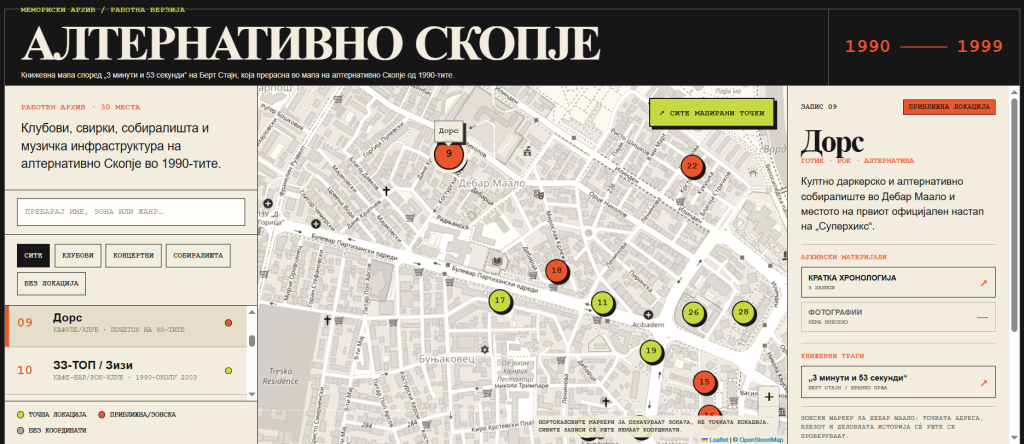
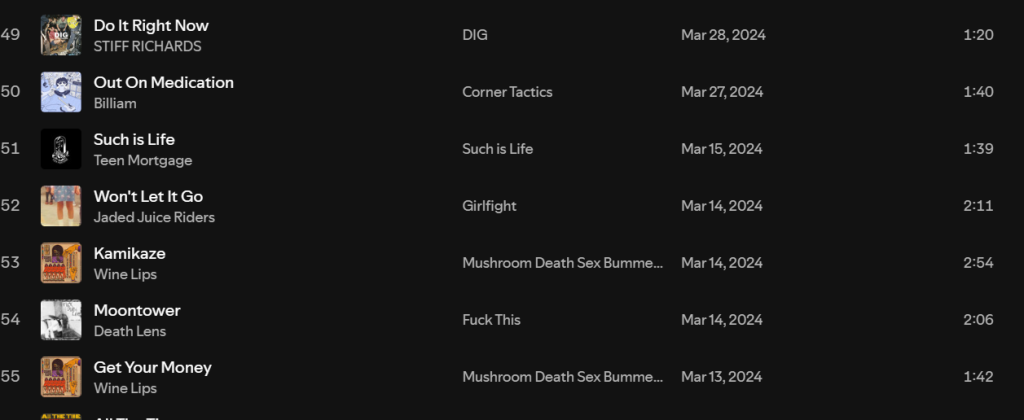
It seemed logical that my Spotify list would be a kind of musical time capsule too. Yet it contained almost no songs from the 1990s or early 2000s. Instead of a museum of my youth, I got a cross-section of contemporary garage punk, post-punk, art-punk and noise rock.
The most represented artists were STIFF RICHARDS, Death Lens, IDLES, Bob Vylan, BODEGA, Fontaines D.C., Teen Mortgage, Wine Lips and Pip Blom. I also have one entirely non-statistical observation about STIFF RICHARDS: a band without a single bad song!
It seems I do not use Spotify to revisit the past. The old songs are already in the tapes, discs, books and that internal playlist that starts up whenever I pass a certain place. What I want from Spotify is something I do not yet know.
My Taste Has Little Patience
The most interesting result of the analysis was the average duration: 2 minutes and 47 seconds. Fully 58 per cent of the songs finish before the three-minute mark. Apparently, I want a band to come in, make some noise, say its piece and leave before I start looking at my watch.
Hence the title. “3 Minutes and 53 Seconds” was named after what was then the average length of a modern pop song. My current list is a whole minute and six seconds shorter! If I ever write a musical sequel, at least I already have the title.
The other numbers fitted the picture too. The average tempo is around 140 beats per minute, and 71 per cent of the songs have an energy score above 0.8 on a scale of 0 to 1. The average is 0.855. In my language: this is not a playlist for quietly humming along while watering the flowers. Unless the flowers like punk too.
Acousticness is almost zero, with a median of 0.003. Danceability, meanwhile, is moderately low at 0.435. Odd at first glance: so much energy, yet relatively little dancing? But there is a difference between neatly following the beat and feeling the need to jump, headbang or join a mosh pit.
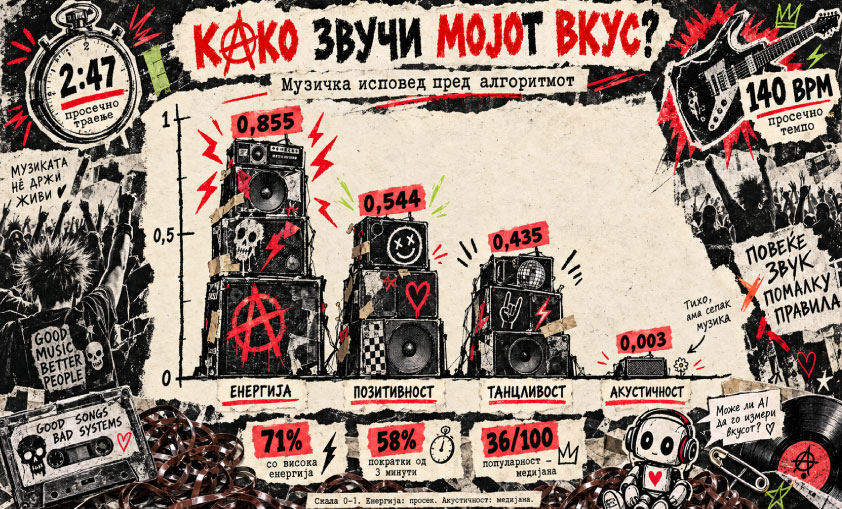
The valence measure, which estimates musical positiveness, sits around the middle at 0.544. Loud and rough, then, need not mean sad. There is anger in this music, but also humour, defiance and a strange joy. That felt closer to my own experience than the simple label “dark music”.
Median popularity is 36 out of 100. That did not surprise me much either. I was more interested in how the analysis managed to assemble a fairly recognisable portrait from so many different songs: guitar-driven, rough, energetic, contemporary and open to crossing genres. Here punk meets psychedelia, electronics, rap and spoken word, without anyone worrying too much about genre purity.
Can a Number Explain Why I Love a Song?
Still, 0.855 does not explain why a particular song makes me want to play it again. Nor does the average tempo say what happened to me on the day I first heard it.
These measures describe certain qualities of the sound. A popularity score is not a quality rating, and musical positiveness does not measure my mood. Nor are my Liked Songs my entire musical life. They are a selection made on one platform, where the algorithm also plays a part in what reaches my ears.
But it is precisely within those limits that the experiment becomes interesting. AI can gather the data, compare it and suggest an interpretation. I can then recognise myself in it, disagree with it or notice something I had not previously put into words.
In my case, the most interesting result was not the decimal but the question it raised: why does someone who spends so much time exploring the past mostly listen to new music?
Alternative Venues as Analogue Algorithms
In the 1990s, music was discovered through people and places. Someone would bring a tape, recommend a band or play something unfamiliar in a club. You could find a new band’s name on a poster, a T-shirt, graffiti or a handwritten list.
The alternative venues on the map formed a network for distributing music, information and ideas. In a way, they were analogue algorithms.
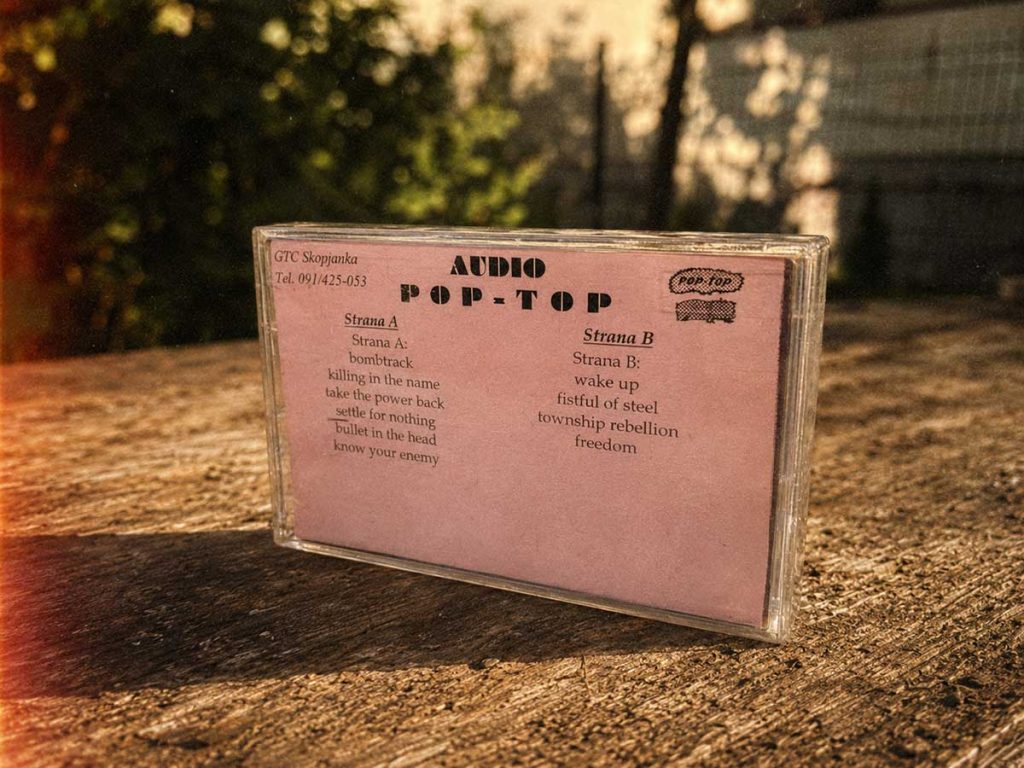
The difference is that back then the algorithm had a face, a favourite table and a bag of tapes. Sometimes it also had very definite views about how the band you were listening to had already “sold out”. Today’s algorithm has no neighbourhood and no memories of gigs, but it can lead me to a band I might otherwise have missed.
It can also keep me within endless variations of the sound I already love. That is why it is worth listening beyond the recommendations sometimes. The most interesting song can still come from a person, a coincidence or a link clicked by mistake.
Try It with Your Own List!
If you have a list of favourite songs, try the same experiment. Before the analysis, write down what you think it will show: do you listen to more old music or new, cheerful or dark, popular or obscure? Then give AI a list of artists and songs, and if you have data on duration, tempo and other features, include those too.
Ask it to distinguish calculations from interpretations and not to invent figures for data it does not have. Then compare the resulting portrait with the one you imagined yourself.
You may discover that your “cheerful” list is quite melancholy. Or that, although you think of yourself as a fan of older bands, you mostly choose new ones. You may get a description you disagree with entirely — which is also a good reason to think about why.
I discovered that archiving the past and listening to new music complement each other well. I explore the past because it disappears all too easily. I seek out new music to see where the ideas that once drew me in have gone next.
AI did not explain my taste completely. But it helped me notice something about it. I do not ask the algorithm to tell me where I have been. I ask it to show me where the noise has moved.