Rekord is one of those places in Skopje that stopped being just a place a long time ago. A name, a direction, a habit, somewhere to wait, somewhere to meet, a point from which the city branches out into a thousand little stories. Around it today are shop windows bearing traces of the past, graffiti old and new, untold biographies, accidental heroes, and an urban stage set that looks as though someone put it together “from memory.” Somewhere here, the stall of Čičko Dragi, as everyone affectionately called him, the Mother Teresa Memorial House, the old Rekord sign, the vanished shops, the new tags, and my need to capture these images before they get shuffled, faded, or erased again all intersect. This search began with one particular piece of graffiti and ended up becoming a much wider story about central Skopje – about what disappears and what remains.
People Leave. Graffiti Stays?
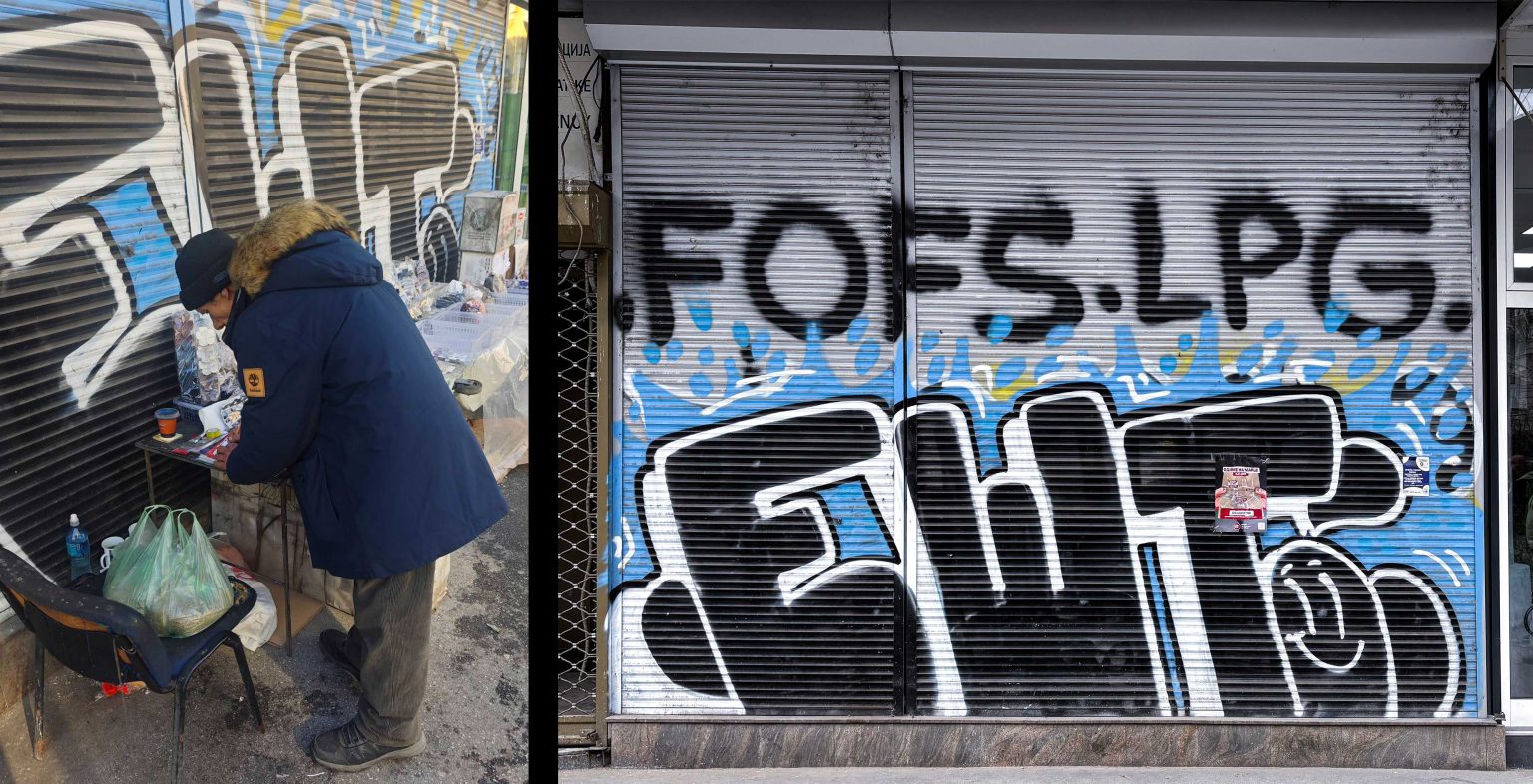
The other day, Čičko Dragi from the old Rekord was on my mind again. One of those Skopje characters who never make it into textbooks, never get monuments, never have a Wikipedia page, but without whom the city would somehow be less human. A poor man. He sold whatever he could to get by. Fed the stray dogs. And, according to a post I shared in “Grafit.mk,” he brought food for the pigeons nearby, too. In her 15 January post in the “Pets” group, Adriana Popovich described him as a man with such a strong sense of empathy and humanity that it was hard to come to terms with the conditions someone like him lived in – literally a “superhero.”
And there, in the photograph behind him, a piece by ESHT caught my eye.
Familiar imagery. Right in the city centre. Somewhere near the old Rekord. One of those places you’re “a hundred per cent” sure you’ve already photographed. Surely we have it archived somewhere in “Grafit.mk.” Surely it’ll turn up when you look for it. But no. Nothing. I ask Goce Tunt, too – my graffiti collaborator and fellow archivist, an immensely talented, creative, intelligent man who persistently dodges public recognition, which is precisely why I’m mentioning him publicly here – and he can’t find the record either.
Weeks went by. Still too early in the season for the bike. A few times I passed Rekord on the bus, but always changed my mind. Bad angle. Bad light. Bad backdrop. Or I was simply in a hurry. Life was happening. And life, naturally, always happens just when you’re trying to catch something before it disappears.
A small digression, but an important one. The real “Rekord,” opposite “Beba,” still exists as a sign. There used to be a bus stop there, too, until the nineties. Then, during Mayor Penov’s time and with the opening of McDonald’s, they moved it to “Bagat,” opposite Zuko’s seed shop, “to keep the crowds down.” McDonald’s, lest we forget, was in Macedonia from 1997 to 2013. And so, through a few urban shifts, the actual place slides away while the name stays put. Rekord is no longer just a location. It’s a habit of speech. A direction. A memory. The old Skopje “meet you at Rekord.”
Finally, the weather warmed up. I got on my bike and set off. And so, on 26 March 2026, I finally photographed the ESHT piece. I wanted to post it alongside the graffiti dedicated to Čičko Dragi. But while putting the post together and looking for a little more information about him, I found out he had died just ten days earlier.
Chills. Again.
A title came into my head: “People Leave. Graffiti Stays.” And just as quickly, I felt disgusted with myself. Sounds good, doesn’t it? Neat. A little sadness, a little philosophy, just right for a post. But what is that if not using someone else’s death for another post and a few more likes? Yuck. And who am I to dish out wisdom about life and death, especially about a man I never knew personally? No. That’s not my job.
My job, at least on this mission, is something else – to archive. To preserve a trace. To try to make a graffiti map through time, showing how a place changes over the years, like those videos where someone takes the same photograph of themselves every year, and then a whole life passes before your eyes in two minutes. Only here, instead of a face – a wall. Instead of wrinkles – a new coat of paint, a new tag, another crossing-out.
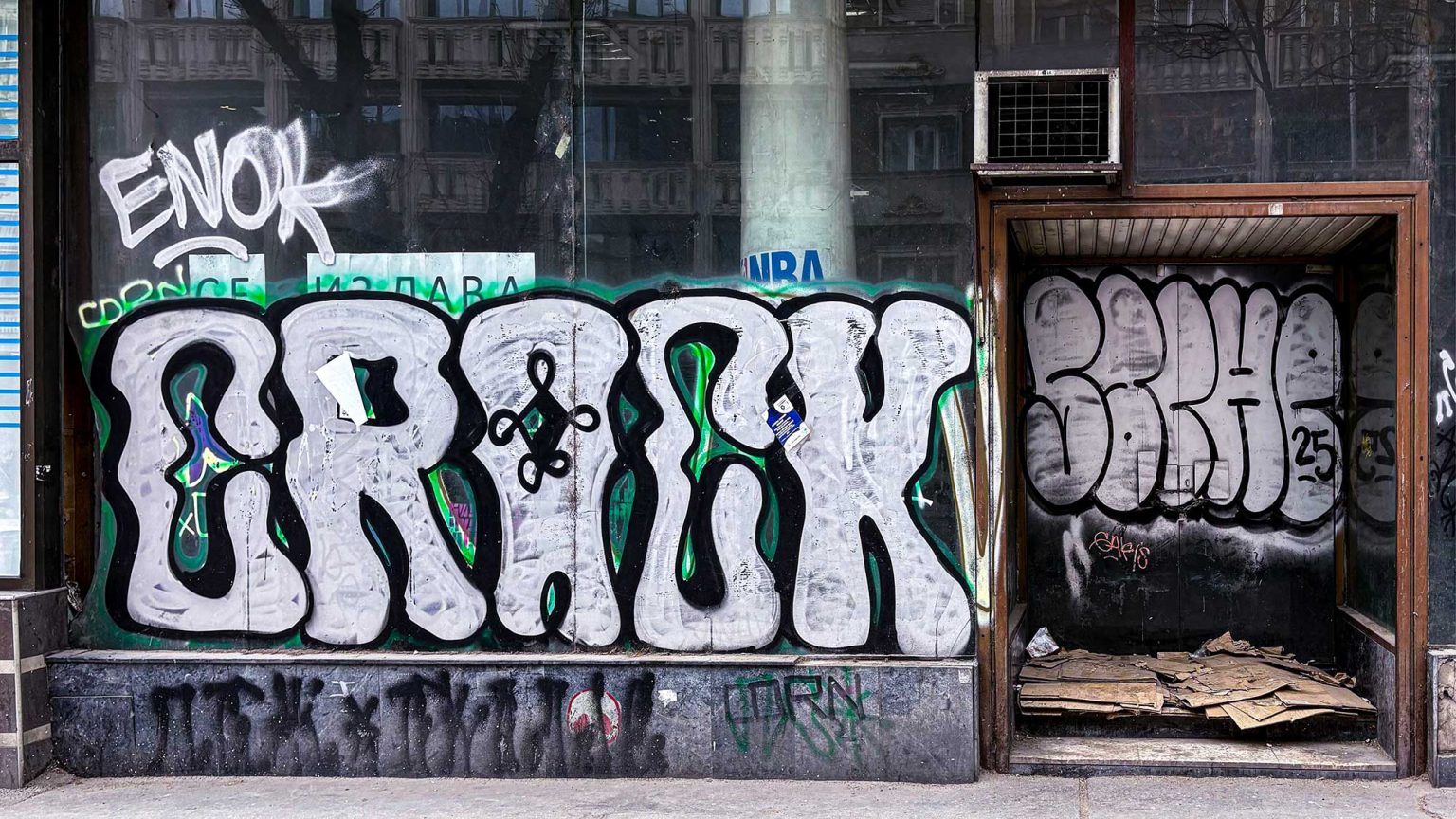
There’s ESHT. Beside it, several more pieces on the shop windows of what used to be the actual, original Rekord: Crack, PSZh Skopje, CORN, PSZh, LOPOV, and others. I know that for some of the “Old Skopje crowd,” those who remember the past more clearly, or at least more nostalgically, these graffiti and the dirt around them are proof that the new Skopje is filthy, neglected, a mess. Maybe they are. But to me, graffiti is something else. Urban markers. Distinguishing features. Place names. Just like Rekord. Only written in spray paint instead of on an old sign.

“Let’s Save Skopje” in VMRO Square
I turn behind Rekord, between the buildings, and right there – a little gift from the city. Vutar on a transformer box. Miks, PSZh ’23, signed high up on a building, just to make it difficult to get close even with your eyes. And down at ground level, something completely different: a cheerful mural, #wecare, We are the world, we are the children. Skopje in a single frame. One eye sees a tag, the other a well-meaning message. One wall speaks in rebellion, the other with an instructive smile. Both belong to the same city. Schizophrenic, as ever.


Further on, I go to see one of Skopje’s most legendary pieces – the grass-headed one. One of those that are no longer just graffiti, but a kind of local folklore. And luckily, and rather miraculously, it’s still in excellent condition. Preserved. Not crossed out. As though the younger generations recognised its worth and decided to show a little discipline here, at least. Or respect. In the same passageway – another Crack, Vutar ’24, and assorted tags. A little shrine to accidental survival.


And there it hits me again: the feeling that Skopje isn’t a city, but a collage put together by a short-tempered pagan god. Layers. Layers upon layers. Trump!? VMRO Square. The Centar municipal branch of the Socialist Party of Macedonia. A lawyer. An old Yugoslav “Iskra” sign. A yellow Vespa parked in front of the graffiti. Everything in one place. Everything in the same frame. As though someone were deliberately testing how far Skopje’s reality could stretch before it snapped.

The graffiti reads: “Vote Trum’h 5000 nobbottsss in play”. I look at it and wonder: does it have something to do with Trump’s first election and our people from Veles, who entered world political history through internet channels, clickbait, lie factories, and a digital circus? Maybe. Or maybe not. In Skopje, you often can’t tell whether you’re looking at a deliberate political statement, an inside joke, sarcasm, or just someone’s impulse shoved onto a wall. A question mark. A big one. In spray paint.
There’s a lamppost here, too, pretending to be “old Skopje.” And which old Skopje would that be? Someone tell me, if they know. Cosmopolitan? Provincial? Turkish? Baroque? Rococo? Vardar? Yugoslav? Macedonian? Skopje has more masks than the average politician, and everyone swears theirs is the original. Behind the lamppost – a building site. You can already see another mushroom cloud of a building about to rise in the middle of this already mutated city centre. Fenced off with sheet metal. On the metal it says: “Let’s Save Skopje.” Well then, let’s save it…
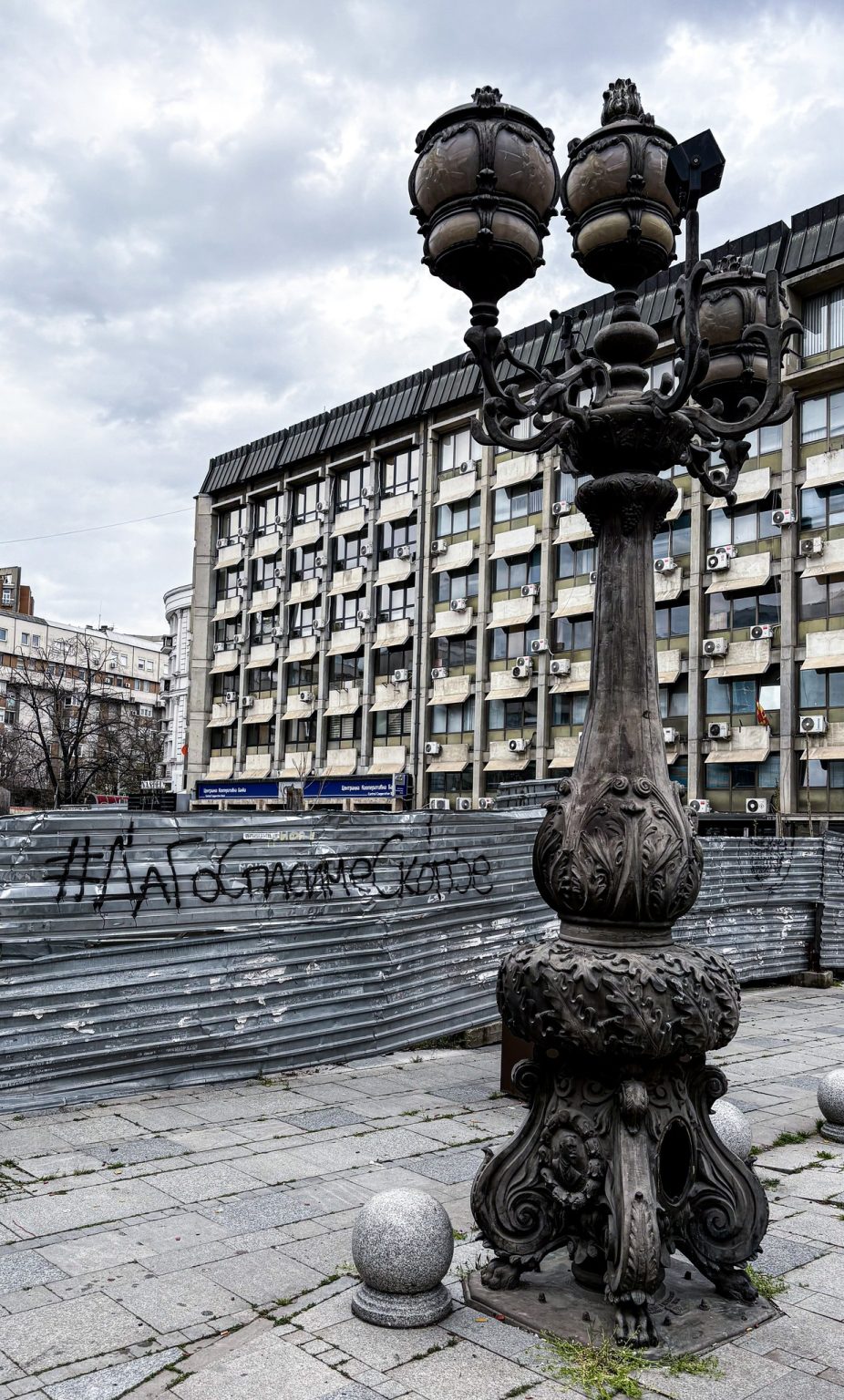
That’s the perfect Skopje absurdity nobody even notices anymore. Behind the slogan about salvation, more concrete. Behind the declaration, an excavator. Behind the love of the city, another intervention the city will need to recover from. And right there, between the grass-headed graffiti, Trump, VMRO, the Socialist Party, the yellow Vespa, and the sheet metal calling for salvation, it becomes clear to me that Skopje stopped falling apart quietly a long time ago. Skopje falls apart loudly. With slogans. With fences. With schizophrenic scenery. And the people of Skopje? They’re in a complicated relationship with the city, too. Everyone loves it, and everyone wants to escape.
The Mother Teresa Memorial House, the “Simić” Shop, and My DNA as a Dowsing Rod
I get on my bike and – as usually happens when you think you know where you’re going – turn the wrong way. Or maybe it isn’t the wrong way. Maybe that’s exactly where the story wanted to go. There I am, outside the Mother Teresa Memorial House. I stand, look, wander around, and remember a sentence my mother said that has been ringing in my head for years: “Our house used to be somewhere around here.”
Somewhere around here.
Now, in Skopje, that “somewhere” can be bigger than an entire municipality. Especially when it comes to family stories passed down by word of mouth, at chance encounters, over lunch, with uncertain street names, half memory and half reconstruction. So I start circling the monument, circling that whole part of the centre, like some descendant turned detective without a map. At that moment, I imagine my DNA, what my ancestors passed down to me, as a dowsing rod. It’ll twitch. It’ll tell me. I’ll feel it when I’m in the right place. Yes, I know. Ridiculous. But when you’re looking for something that no longer exists, you’ll clutch at methods like these, too.
My mother’s stories about the place are fragmented. She doesn’t tell them as a chronicle, more as scenes lifted from an old film, in no particular order. According to her, our family moved from Kruševo to Kočani, where my great-grandfather Gjorgji Sima was mayor of Kočani (in Ottoman times?). Though we couldn’t find any record of it there. Maybe he was, maybe he wasn’t, maybe he was something else. That’s how these little domestic mythologies work. But according to that same family narrative, they moved to Skopje in the 1920s and lived somewhere here, on Kralja Petra Street (today’s Makedonija Street), around the present-day Mother Teresa Memorial House and the former Catholic church. And they didn’t just live here: in the 1920s, they also had a fashion tailoring shop. Simić.
And they didn’t just live here: in the 1930s, they also had a fashion tailoring shop. Simić.
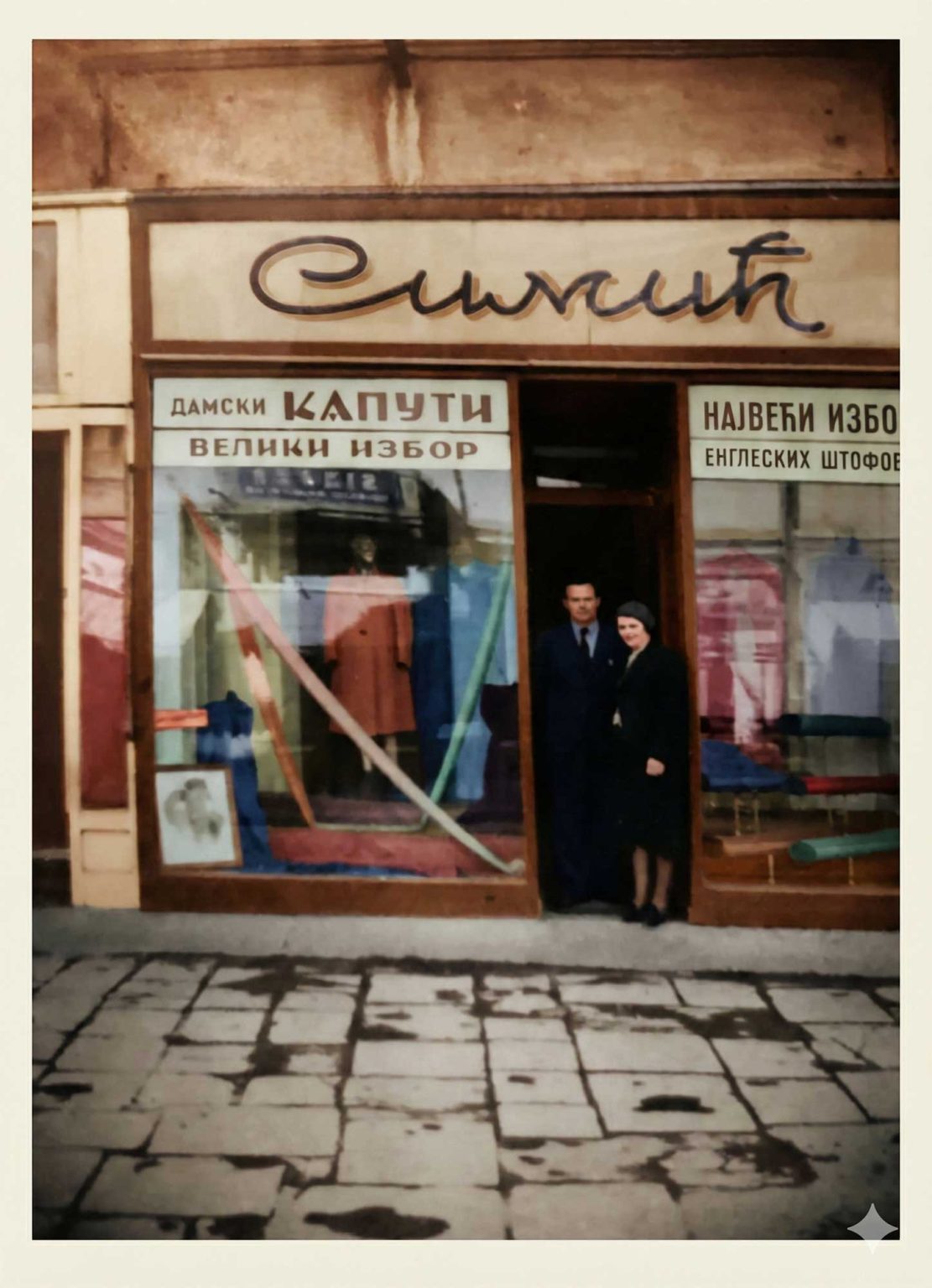
How many lives, conversations, fittings, measurements, waists taken in, shopfronts opened, and morning clean-ups a name like that can hold. And that’s why it eats at me that today nothing is left of it but a word. After the Second World War, according to my mother, they gave the family house in Pajko Maalo to their daughter-in-law. She had lost both her husband (my grandfather’s brother) and her child in the war. That one sentence alone is an entire novel nobody ever wrote. And they moved to Debar Maalo, to the house now known as the “Pensioners’ Home.”
Then comes one of those Skopje family episodes that sound like urban legends, yet are passed down with all the solemn certainty of fact: one night, a Russian general appeared, saw the house, and declared his love for it with the words “Ya lyublyu.” And that was enough. The whole family moved out overnight. In Skopje, honestly, stories no less absurd sound entirely possible.
After the earthquake, my grandfather Džika Sima was given a prefab house in Taftalidže. That’s another familiar Skopje fate. Prefabs. Temporary things that last far too long. A city patched together with sheet metal, wood, concrete, hope, and improvisation. But later, when he bought a flat in Debar Maalo – in a house built in 1938 by his father-in-law, my other great-grandfather – Džika, an honest man and a merchant of the old school, returned the prefab to the City of Skopje.
Returned it. That belongs to another moral universe. To some old, faded Skopje that may not have been quite as ideal as we like to think, but certainly lived by a different code.
And when I gather all these traces – the house in the centre, the prefab in Taftalidže, the house in Debar Maalo, my great-grandfather’s factory, the flour mill in Gazi Baba beside the motorway – nothing remains of any of it. Nothing material. No house. No shop. No prefab. No mill. Just traces in stories. Just a few coordinates floating through the family memory. Just me, on a bike, circling the Mother Teresa Memorial House and trying to guess where my little vanished family archipelago once stood. btw, I feel nothing. Not a single vibration.
The material things in my life, just as I try to bring them together into one picture, start to look like graffiti. They appear. Stay for a while. Someone crosses them out. Someone (or something) tears them down (did I tell you I was born in central Sarajevo, in Stari Grad, and that I have nothing left there either?). Someone builds something else over them. And then all that remains is the question: were they really here, or are we just desperately looking for a trace that something of ours once existed?
Behind Rekord Again
Then it occurs to me that my graffiti mission has quietly wandered into something else – a middle-aged man’s improvised, half-conscious search for his own origins. From wall to wall, from tag to tag, I’ve ended up circling family shadows, houses that no longer exist, and stories that were never fully told. Tired, I tell myself: enough, I’m done with this part of the centre, the story has said its piece. And then, as though the city won’t let me get away that easily, a Pack in the passageway opposite the Mother Teresa Memorial House pulls me back. Beside it, a similar Vutar 2024, then Korbo, Vutar 23, INA, Krki, and others. That’s how graffiti works – it doesn’t call out to you, it tugs at your sleeve. Most people don’t even notice it, or notice it only to complain. One tag, then another, then a little further, and you realise you’re behind Rekord again, in another pocket of the same urban maze.


A young woman wants to walk through the passageway. She sees me taking photographs and stops, steps aside, waits for me to finish. That small, ordinary Skopje courtesy always moves me. A city that can be rough, dirty, irritable, unfair, falling apart – and in that very same city, someone will stop to stay out of your frame. Despite everything, the people of Skopje can be considerate. And kind. Like pedestrians thanking drivers who stop to let them cross. And that’s why, sometimes, I feel even sadder for this city.
Further on: Lopov, Busk, Corn. PSZh. ACAB F*ck You All, and a Drash from 2011! On an old house, on the other side of the “Rekord” burek shop. The wall is a story in itself: a little history, a little neglect, a little rage, a little territory, a little vandalism, a little art, a little “might as well put my name here, too.” You can’t neatly separate these things. And why would you? The city doesn’t.
And behind the old Rekord, I find a proper gallery of generations of graffiti writers. Mostly the younger ones, active over the past ten years or so: Rubik, PSZ, BUSK, KER, Aris 25, ASHE, PACK, VUTAR, and Choser, the man whose skull illustrations have almost created a Skopje school of their own. A little catalogue of the newer Skopje. A kind of urban directory, written without permission, but with far more life than the official signs on institutions.
I come to an entrance and recognise it immediately from the graffiti. I’ve been recognising the city by its graffiti for a long time now. I find my way by it better than by street names, and far better than by urban plans, which are more science fiction than documents anyway. Here they are: “Che Ve Vara,” “Life: 100 Days of Lies,” a stencil of Goce Delčev. And immediately I remember – this is the building where Brett McMahan once stayed, the American from Alabama, a world traveller who grew to love Skopje, and Skopje him, in that way the city sometimes adopts strange, good people from elsewhere more readily than its own.

He’d posted the “Che Ve Vara” stencil in a video, and people in the comments were explaining its political meaning to him. That’s how I found out what the stencil meant, too. Sometimes I’m so detached from politics that it borders on being uninformed. Not neutrality. Not distance. Idiocy. Which is why it amuses me when a wall gives me a crash course in politics better than the entire media landscape.
There’s a good Joker stencil here, too. Someone has scrawled an anarchy symbol on his forehead – which, honestly, doesn’t look bad on him. Beside it, “Be a Wonder Girl,” a slogan of mine from a campaign! Moments like that make me happy: when your personal archive suddenly collides with the living city.
A Drash Oks and an SRK from 2014 look like relics. Graffiti from that time rarely survives in Skopje. Especially in an area like this, where everything is quickly wiped away, covered up, tidied up, or destroyed. Which makes it all the more interesting that opposite them there’s a brand-new piece by Drash and Miks. Generations meeting. Less a ceremonial passing of the baton than a quiet urban conversation: here I am, still here, and here’s the new layer beside me.
The Miks ideogram smiles at me there, because for a long time I mistakenly identified it as the mark of the Prestige crew. I’m fond of mistakes like that. They show that even when you think you know the city, it still reserves the right to have a little laugh at your expense.


Finally, I enter the passageway beside the Hunting Federation of the Republic of Macedonia, and there I’m greeted by original murals and what may be the most imaginatively decorated passageway in Skopje. One of those places you don’t plan on finding. Places that make you realise that behind Rekord there isn’t just “behind Rekord,” but a whole little parallel city. With its own codes. Its own signatures. Its own generations. Its own walls that refuse to keep quiet.
Graffiti Neighbourhood #2
I carry on down Makedonija Street, towards the Old Railway Station, and turn towards Goce Delčev Primary School, where I discover another “graffiti neighbourhood.” Why another? Well, here’s the thing…
“Pločnik” is a legendary spot where young people have been gathering since “my day,” right up to the present. There were several routes on our map, and one of the most well-trodden began outside the cathedral, with drinks on the benches, then continued to “KIM,” to “Zot,” for gigs and table football – a place where hits by The Police were a regular part of the repertoire. From there, we headed towards the Bunjakovec shopping centre, to Little Bravo or the basement “Energy,” then towards the City Wall complex, behind the Construction Workers’ Hall, to “SF,” and back towards the City Park and the benches by the Lotus fountain. The evening usually ended at “Music Garden” – the garden of alternative youth. Rock, metal, goth, and grunge were the soundtrack to the whole route. Even the trendy crowd knew Nirvana, and rock dominated MTV. Today, all of that sounds like local mythology we’ll soon have to defend with archival evidence.
And that’s why I mention Pločnik. Because on this adventure, which began by following traces of Čičko Dragi, I stumbled across another place like it. Or, better put – a place that demanded a name of its own. Naturally, if Pločnik is Graffiti Neighbourhood, this is Graffiti Neighbourhood #2!
I head towards Goce Delčev Primary School, and there, in the surrounding area, suddenly – boom. An incredible wealth of graffiti. So much that I can’t shake the spontaneous thought that this isn’t just a collection of painted walls: it’s a whole neighbourhood talking to itself through spray paint. My old friends ESHT greet me from high up on a building, as though keeping watch from above. Below them, DOSP. The surroundings are grey, battered, and the old lustre of the housing blocks has long since been displaced by some triumphant shade of concrete grey. And precisely because of that, the graffiti hits all the harder. Colourful Aris. Morgan. ASHE. And others. A Goce Delčev stencil on a transformer box. As though history refuses to stay in a textbook here, too.
Beside the school, a Sunshine that brings SRK to mind. Some romantic has written “Love Her.” Someone else, with different priorities: “Where’s Boki 13’s Bag, Zoki?” There’s Skopje for you in three strokes: love, graffiti genealogy, and the politics of the day. On the underground garage, meanwhile, ARIS, SMUT, Snake. In several places, stencils by “Parkobrani” – park defenders, people holding hands and protecting the parks. As they should. Without parks, we’re just concrete and asphalt. Asphalt and shades of grey. Asphalt and frayed nerves.


I carry on. ARIS again. Bonus. Morgan. PACK 25. ASHE. And others. One by one, as though the city were taking its own roll call. The garage on the other side of the school looks like a nuclear bunker. Or the aftermath of a nuclear war waged slowly, quietly, and administratively. Tags everywhere. Busk. Crack. Rubik. SRK. ESHT. Kris. Painted-over shop windows. Cracked façades. Right in the centre. Not the outskirts. Not an industrial zone. The centre. That’s the trouble with Skopje: you never know whether you’re looking at urban culture or a symptom of a transition that just won’t end.


The blue buildings are covered in graffiti. Here, the younger generations practise on a canvas people live inside. Someone sleeps behind that wall. Someone hangs out washing. Someone argues. A child learns the multiplication tables. And outside: Ink, Bone, Trip, Sumo, Rex. Beside them, the more experienced ones, too – MIKS PSZ, Vutar, Zork, Ashe, their names unusually written in Latin letters. Politics couldn’t resist getting involved again, so the stencil “Zaev’s Bloody Hands” appears as well. Around here, even when a wall just wants to be a wall, someone will slap politics onto it.
Here, that old, uncomfortable question catches up with me: what exactly have I discovered? Just graffiti? Or something more? What lies between the layers of paint, the peeling façades, the transformer boxes, the garages, the school, the slogans, the love notes, and the seemingly random tags? What is there between urban culture and personal history? Between my archive and the history of a city that keeps pushing itself away from itself?
Honestly, Skopje should have changed its Facebook relationship status a long time ago, from “In a relationship with the citizens of Skopje” to: “It’s complicated.”
Exactly that. I don’t know whether there’s another city people love and hate so much at the same time. They love what it used to be. They don’t like what it is now. They love the neighbourhoods, the little histories, the old places, the strange characters, the local myths. And at the same time, everyone wants to escape. Or at least thinks they do. But before they escape, they leave a tag. A mural. A stencil. A love note. A political curse. Something on a wall. Just to leave a trace that they were here.
And perhaps that’s what the whole thing comes down to. That Skopje, however far removed from what it once was, mutated, dug up, torn apart, still hasn’t stopped showing signs of life, and sometimes even manages to outdo itself. You just have to know where to look.
