What happens to a newspaper after it stops appearing? Copies remain in libraries, piles of paper in people’s homes, clippings kept for some personal reason. And its online archive? That should be the most easily accessible part of its life.
With the Utrinski Vesnik website, things are more complicated. Some of the old pages still open. Others return a broken link. Some promise one issue but display an entirely different one. The headline exists, but the article behind it is inaccessible. The archive has survived in fragments, like a newspaper whose pages have been scattered and lost in someone’s basement.
At Arno.mk, we have started gathering those pages. Visit our project here.
October 2006, Twenty Years Later
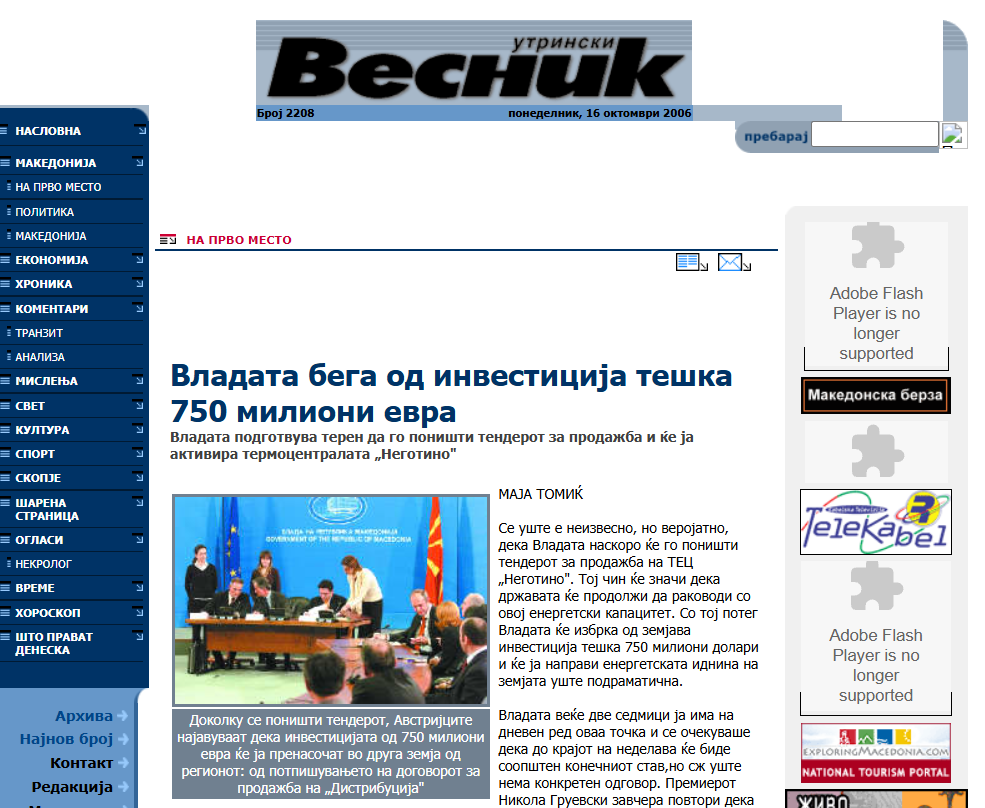
To begin with, we chose a single month: October 2006. Now, in October 2026, exactly twenty years separate us from those news stories. Enough time for some announcements to become reality, others to be forgotten, and still others to acquire a significance that no one could have foreseen at the time.
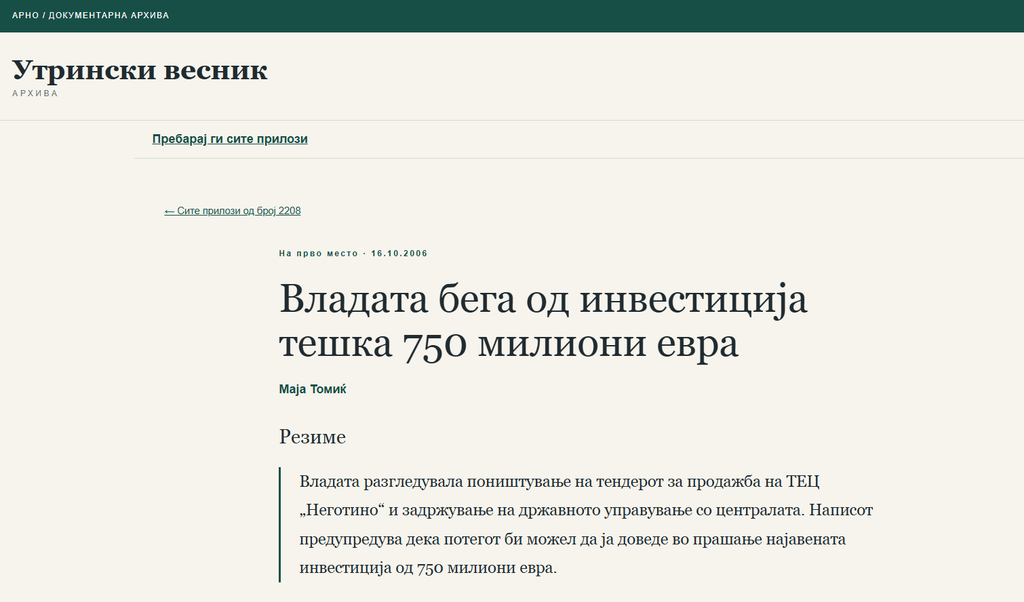
We began with the available articles from issue 2208, published on 16 October 2006. We are cataloguing the headlines, authors and sections, and linking them to the original pages. Where a photograph or PDF has been preserved, we provide a link. Where something is missing, we make that absence visible too.
The work sometimes resembles digital archaeology. A promising-looking link may lead to the wrong year. A preserved front page does not guarantee that the articles have survived as well. Each fragment we find therefore needs to be checked before it can take its place in the reconstructed whole.
The Story Continues
From the outset, the central idea behind this archive was to preserve the news and use it to ask ourselves again where we have been, what we have done and where we are heading.
Our guiding thought, as in many of our other projects, was Krste Petkov Misirkov’s well-known question from On Macedonian Matters: “What have we done, and what should we do from now on?”
That is why, as we reread Utrinski, we keep returning to one question: what happened next?
The government was considering the future of the Negotino thermal power plant. The contract with Delta for the construction of a shopping centre had been terminated. Skopje’s cinemas were closing. For readers at the time, these stories were still unfolding.
Today, we can follow what came afterwards. We can investigate what was built, what fell through, which project changed owners or names, and which problem remained unresolved.
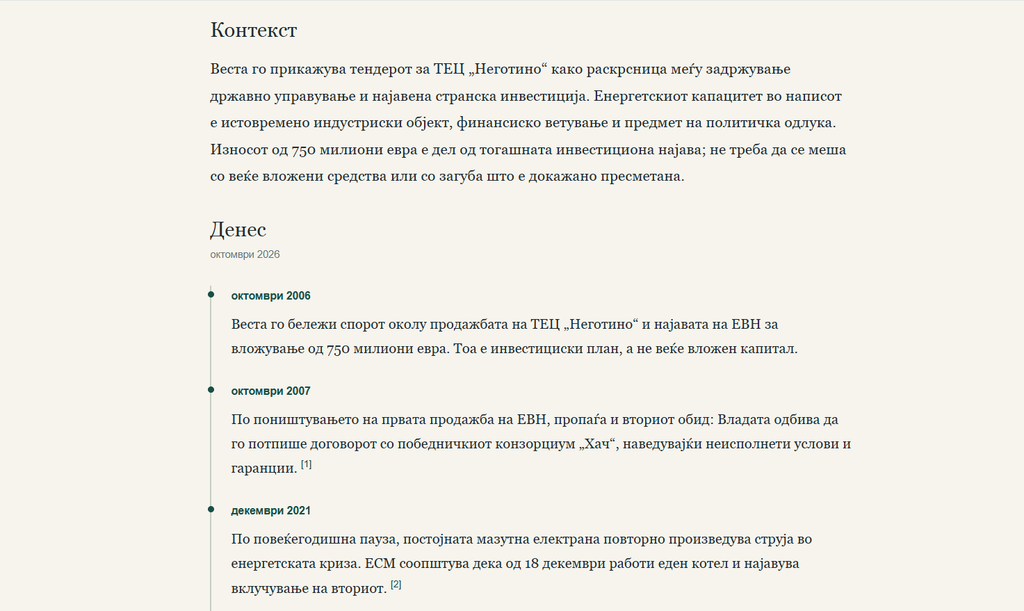
We therefore organise the news stories we work on into three parts:
- Summary — what Utrinski Vesnik reported.
- Context — the period and social circumstances in which the story appeared.
- Today — what followed, with a brief timeline and verifiable sources.
The original article remains a record of its moment in time. Our present-day research builds on it, clearly separated from the journalistic text. When we cannot confirm what happened, we say so.
In this way, an old investment announcement can become a story about twenty years of economic decisions. A report about a cinema closing can help us trace changes in the city’s cultural life. A short local news item can reveal just how long a seemingly temporary problem can last.
A Newspaper as a Map of Its Time
Utrinski recorded major political events, but also everyday life: late buses, water supply systems, schools, exhibitions, books and sporting events. It is precisely in their proximity, on the pages of a single issue, that a society comes into view.
In rebuilding the archive, we want to make those connections accessible again: to allow people to search, move from one topic to another, and follow how a story has changed over time.
This continues our interest in old newspapers and time capsules, while also offering a practical response to a problem we have already written about: digital memory does not preserve itself. Someone has to find the scattered fragments, check them and reconnect them.
An Archive We Will Keep Expanding
We are starting with a small, clearly defined scope: Utrinski Vesnik from October 2006. Ahead of us are gaps and an uncertain search for the next available articles.
If you have copies of Utrinski Vesnik, scans, clippings or saved web pages, please get in touch. Corrections and additional information about the subsequent course of the events we cover are also welcome.
Twenty years ago, these stories were read over morning coffee. Today, we open them again with one more question alongside them: what do they tell us about the path we have travelled since then, and the road ahead?
