From an initial literary map to an open research archive featuring 74 clubs, concert venues, cafés and informal gathering places
The interactive map “Alternative Skopje in the 1990s” (beta version) has reached its official research version 1.0.
Initially conceived as a literary map inspired by Bert Stein’s 3 Minutes and 53 Seconds, it has grown into a broader map of alternative Skopje in the 1990s.
Unless otherwise indicated, linked content is in Macedonian.
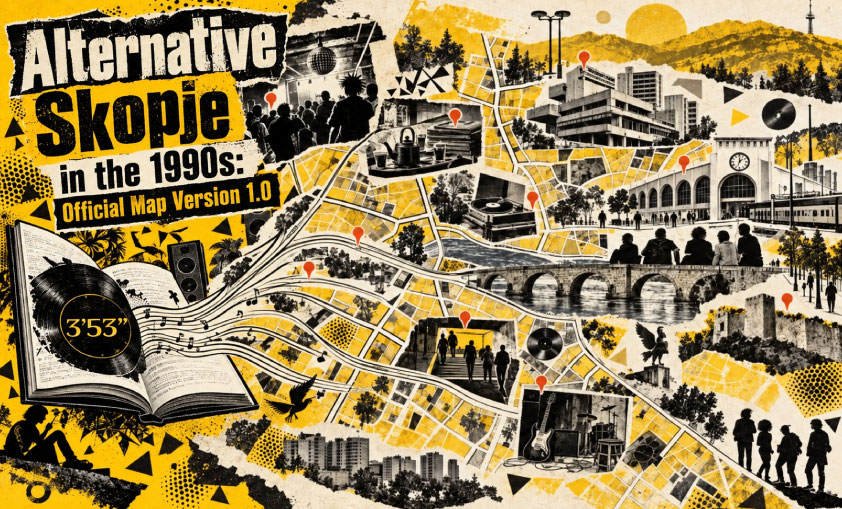
We have already written about the origins of the idea, the initial list drawn from personal memories and the project’s methodology in our first article about the map. Since then, thanks to the many responses, additions and new lines of research, the map has expanded considerably and become more accurate.
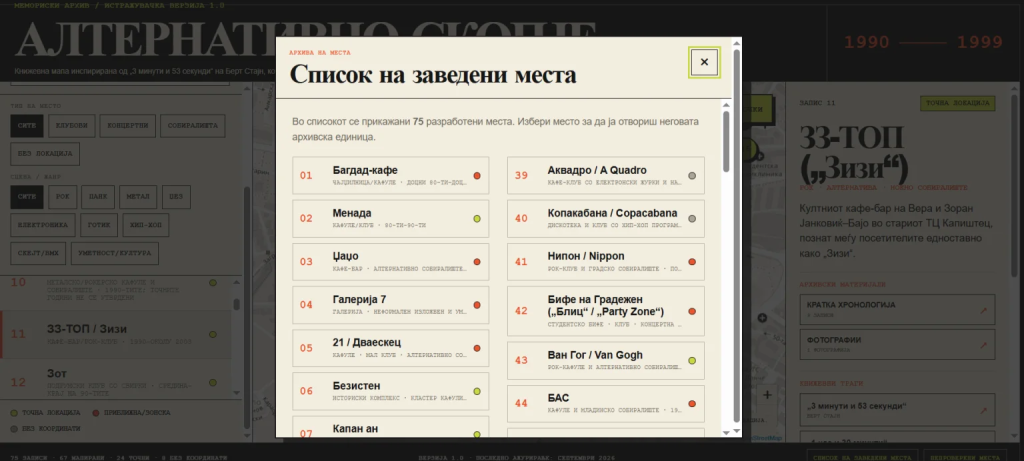
Version 1.0 introduces search and filtering by type of place and music scene, clearly distinguishes between exact, approximate and undetermined locations, and includes expanded timelines, photographs, literary traces and sources. We have also added an automatically generated “List of Recorded Places”, from which users can browse and directly open all 74 archive entries, as well as a separate list of “Unverified Places” awaiting new information and testimony.
From the First Public Version to 74 Archive Entries
The first version, containing around 30 entries, was an attempt to collect and spatially connect the places that remained in the memory of a generation. Following its publication, we received new names, corrections to locations, information about owners, musicians, DJs and concerts, as well as details about the succession of venues that had occupied the same premises.
Version 1.0 contains 74 fully developed entries: clubs, concert venues, cafés, teahouses, galleries, neighbourhood bars, parks, pavements, benches and other informal gathering places.
In addition to the well-known locations in the centre, the map now presents the city’s wider network: the Bezisten and Old Bazaar, Bunjakovec, Kapishtec, Debar Maalo, Novo Maalo, the City Wall, Leptokarija, Chento and other parts of Skopje.
This makes it even clearer that alternative Skopje was not confined to a handful of famous clubs. It was a dispersed social network in which a neighbourhood café could become a citywide alternative hotspot once a week, a grill kiosk could turn into a late-night gathering place, and a set of steps, a few benches or an ordinary pavement could acquire its own name and a place in a generation’s collective memory.
Testimonies Opened Up New Routes
Most of the new findings emerged from public responses by people who had visited the places themselves or taken part in their programmes. Their testimonies helped us locate forgotten venues, distinguish between places with similar names, and uncover connections between different generations, social circles and spaces.
We would like to thank Miša Popović, Nevenka Stojanovska, Petar Mladenovski, Viktor Delevski, Tošo Filipovski, Žarko Maslarkovski, Vlatko Lakardov, Vasil Buraliev, Uroš Veljković, Zoran Velkovski, Milan Damjanoski, Hypnaswan Su, Vlatko Čačorovski—Čole, Aleksandar Mihajlovski, Ana Čuškova, Aleksandar Andonovski, Goce Adamčevski, Toni Dimitrov, Zdenko Petrovski, the Institute of Gender Studies, Dušica Dimitrovska, Nataša Avramovska, Igor Velkoski, Aleksandra Simova, Andrej Marjanović, Irenka Sirenka, Tatjana Aleksandrovna, Matej Bogdanovski, Nikola Pijanmanov, Viktorija Stefkova, Marija Pendeva, Mirjana Ivanovska, Žarko Kargov, Maja Naumova, Ksenija Janeva-Nikolova, Petrula Kostovska, Bojana Srbljak, Matilda Sadikario-Kostovska, Jane Bojadžievski, Dule Damjanovski, Iskra Aneva Makić, Gavrilo Milovanović and others for their contributions.
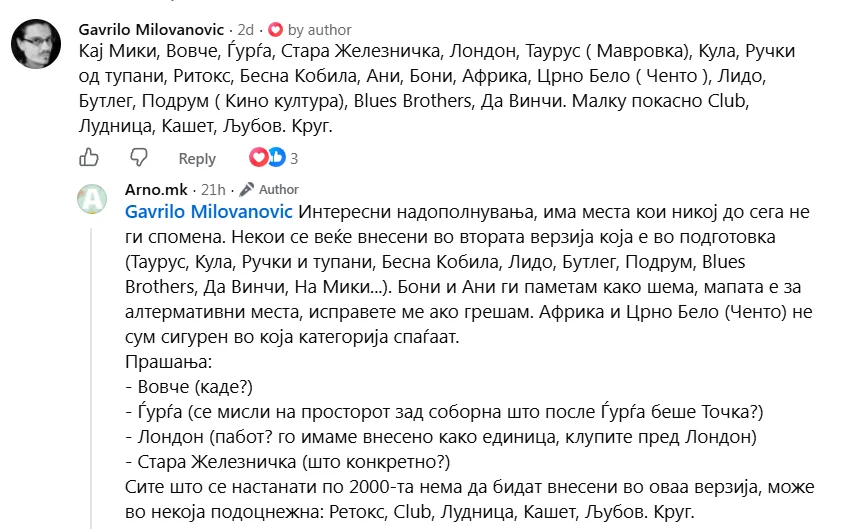
Some testimonies revealed entirely new locations. Others corrected mistaken assumptions. In several cases, we established that two names represented successive phases of the same venue; in others, it became clear that two venues should remain separate even though they had been situated very close to one another.
Particular attention has been paid to the distinction between firsthand memory and independently verified information. Not every testimony automatically becomes an established fact, but each one can offer an important lead for further research.
More Sources and More Precise Timelines
In version 1.0, the timelines and sources for many of the places have been expanded. Personal memories are cross-referenced with old magazines, books, interviews, business directories, concert announcements, photographs, forums and archived websites.
Written traces that allow certain venues to be dated more precisely are particularly significant. The magazine Margina, for example, preserved literary and documentary scenes from the teahouses and café-galleries of the Old Bazaar. Interviews with musicians and artists reveal where the first performances, rehearsals, exhibitions and long conversations took place—the latter often being just as important as the official programme.
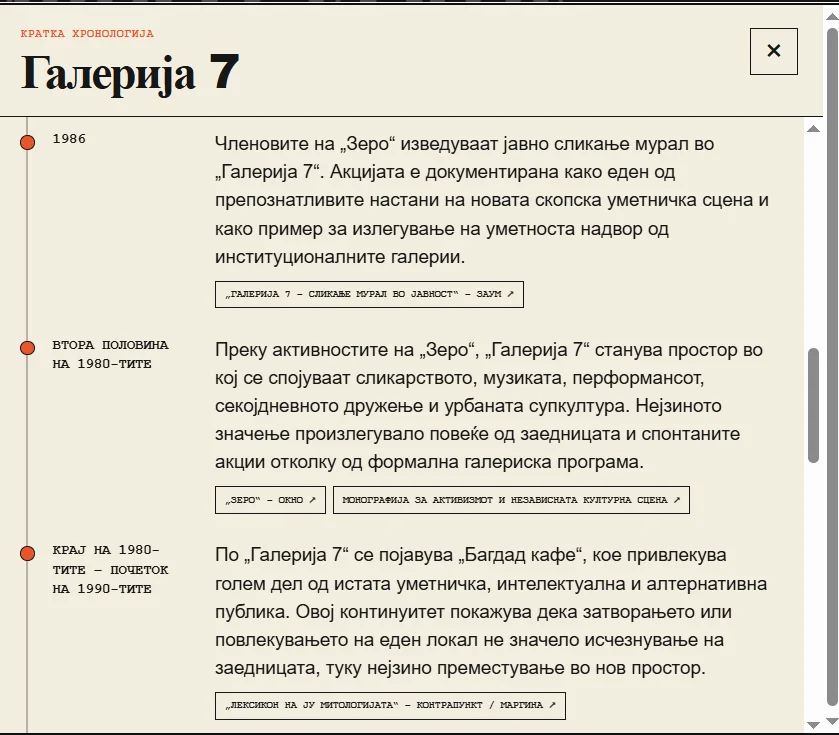
For every place, we aim to distinguish clearly between what has been confirmed, what has been inferred by comparing multiple sources, and what remains a working hypothesis.
Exact, Approximate and Undetermined Locations
One of the most important improvements is the clearer indication of location certainty.
Places on the map are now divided into:
- locations that can be precisely linked to an address or a specific building;
- approximate locations or zones, identified through nearby landmarks;
- places without coordinates, for which there is still insufficient spatial information.
A zone marker does not claim that the venue occupied the exact shop unit marked on the map. It indicates the part of the city in which further research should continue. For some complexes, such as the Bezisten or the basement of Bunjakovec Shopping Centre, we know the building but not the exact entrance or commercial unit.
It is better for a place to remain temporarily without coordinates than for an incorrect assumption to begin circulating as fact over time.
New Search and Browsing Options
Version 1.0 allows places to be searched and filtered by type of space and the scene with which they were associated: rock, punk, metal, jazz, electronic music, hip-hop, goth, skate culture and art.
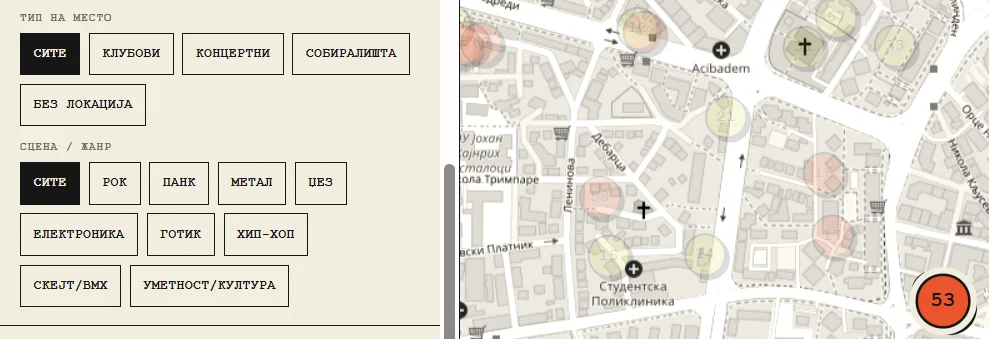
An automatically generated “List of Recorded Places” has also been added, allowing users to browse all 74 archive entries and directly open the selected place.
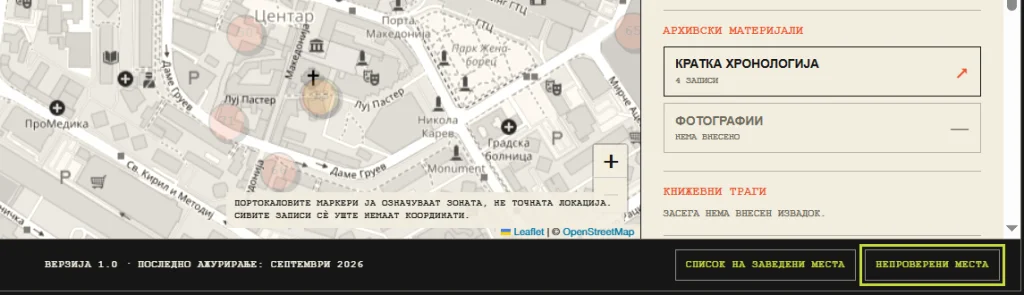
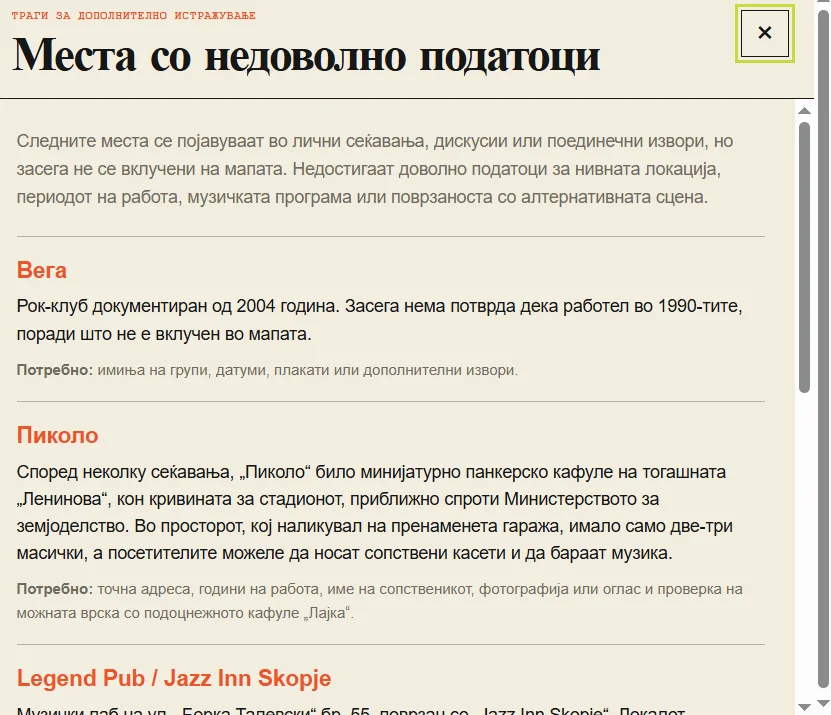
The “Unverified Places” list appears separately. It preserves names mentioned in memories or individual sources for which there is still insufficient information to create a full entry. In this way, the leads are not lost, but neither are they presented as fully verified.
What Remains for Future Versions?
The research does not end with these 74 entries. Several places for which relevant leads already exist—including Fox in the Old Bazaar, Sajmište, Bratstvo, Šeneda, Sputnik and others—have been left for the next version so that they can be given sufficiently detailed timelines and more reliable archival support.
Places such as Speed, Piccolo, City Pub, Čeh and others remain on hold for now. Their names appear in memories and conversations, but we still do not have enough verified information about their exact period of operation, location, programme or connection to the alternative scene. Rather than adding them on the basis of assumptions, we will keep them among the open research leads.
We have also deliberately omitted from version 1.0 venues that emerged after 2000, such as Retox, Club, Ludnica, Cachet, Ljubov, Krug, Vega, Mamas—in the phase when it operated as a jazz café with live performances, before becoming a nightclub—Legend Pub/Jazz Inn, D Club and others.
Although some of them directly continued the scene created in the 1990s, including them would blur the clear chronological boundary of the current map. They may find a place in a future, expanded map dedicated to alternative Skopje in the twenty-first century.
Version 1.0 Is Not the Final Version
The 1.0 designation means that, for the first time, the map has been shaped into a complete and functional research resource. It does not mean that the history is finished or that all the information is definitive.
On the contrary, this archive can become more accurate only through the participation of the people who remember these places.
We therefore invite former visitors, musicians, DJs, bartenders, owners, organisers, artists and everyone who was part of the city’s cultural life at the time to explore the map and help us continue expanding it.
We are particularly interested in whether:
- a place has been incorrectly located;
- a venue has been incorrectly classified as alternative;
- two different places have been mistakenly merged;
- a single place has been unnecessarily split into multiple entries;
- an important club, café, concert venue or gathering place is missing;
- the exact years of operation are known;
- there is information about who ran the venue and created its programme;
- there is information about which musicians, bands and DJs performed there;
- it is known what occupied the premises before the venue and what came afterwards.
The most valuable contributions are personal memories accompanied by physical evidence: photographs, flyers, posters, concert tickets, membership cards, invitations, advertisements, newspaper clippings, menus, address books, video footage or audio cassettes.
What appears insignificant at first glance can matter too. A birthday photograph, a table with a few bottles, a basement entrance or a shop sign accidentally captured in the background may sometimes be the only surviving visual evidence of a vanished place.
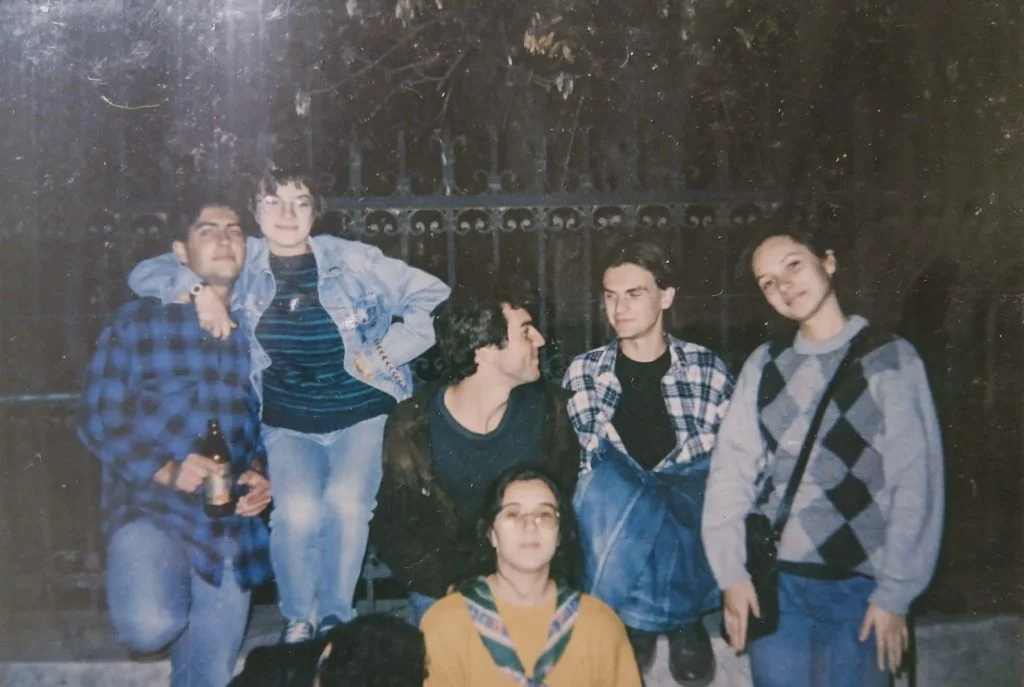
Mile (from “Poni”, “Mojo” and “Bravo”), freshly returned from the Yugoslav People’s Army (JNA)—hence the shaved head—with Radmila beside him, Božo, Goko and Cece; below them, Dare (also with a shaved head after returning from the JNA) and Tatjana Aleksandrovna, who sent us the photographs, sitting on the low wall outside the Municipality of Centar (opposite Van Gogh)
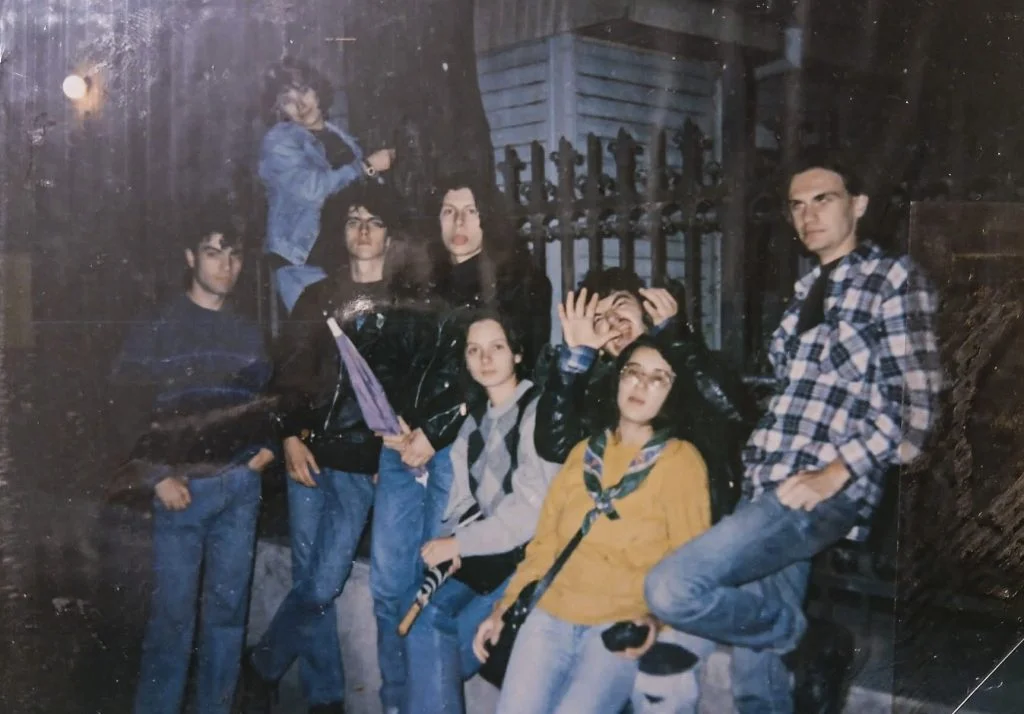
The same people as above, joined by Picek and Dule (photo source: Tatjana Aleksandrovna)
An Open Archive of a Vanished City
“Alternative Skopje in the 1990s” does not attempt to create an idealised image of the decade. Its aim is to preserve the city’s different, sometimes contradictory experiences and to show how they can gradually form a shared cultural topography.
The map will continue to be expanded and corrected. Each new version will add another layer to the reconstruction of a city that has physically disappeared, but still lives on in photographs, music, language and people’s memories.
Open the interactive map “Alternative Skopje in the 1990s” →