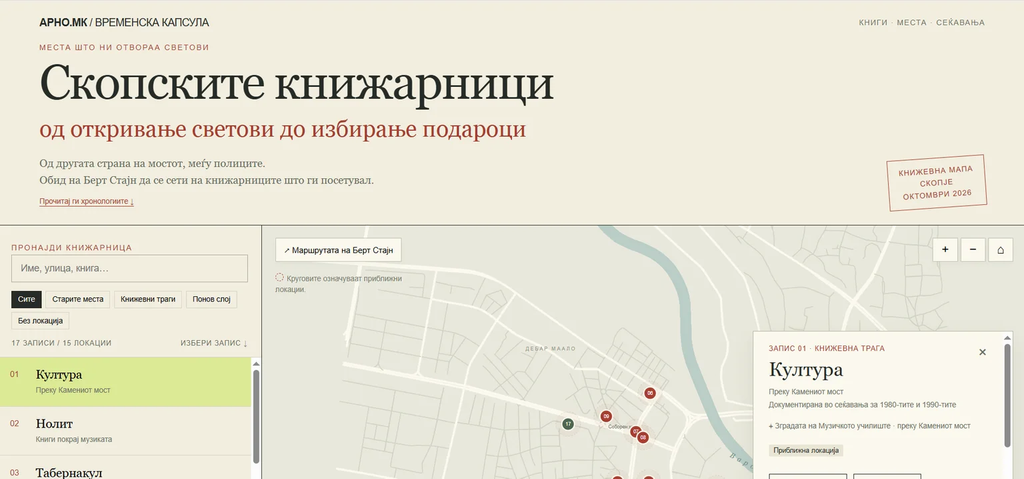
After we published our map of Skopje’s bookshops, the writer Dimitrie Duracovski got in touch with an excerpt from his novel Sometimes They Come Back (Ars Libris, 2026), in which he revisits the Kultura bookshop in the Ristiḱ Palace in 1973.
From coffee at Pelister to browsing the bookshop shelves, Duracovski takes us through a youthful memory of longing for books, friendship and Skopje more than half a century ago. With the author’s permission, we are publishing the excerpt as a literary contribution to our map.
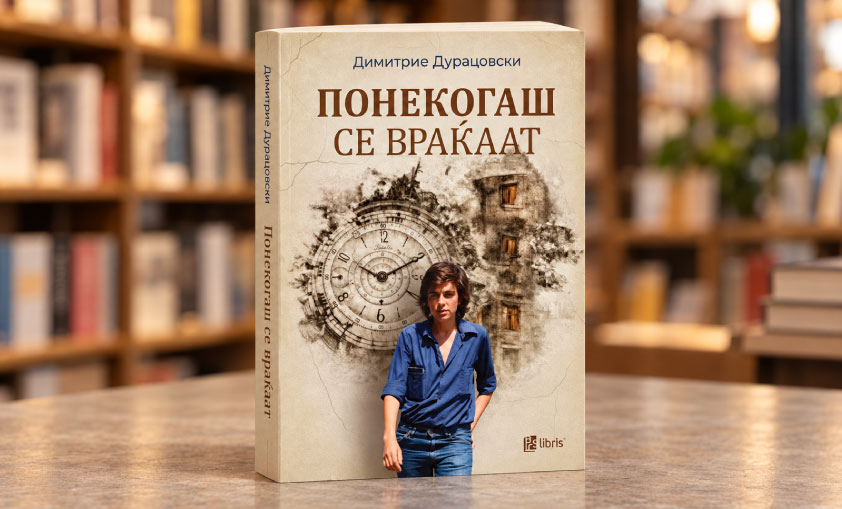
Dimitrie Duracovski
Sometimes They Come Back
A fragment about the Kultura bookshop in the Ristiḱ Palace, 1973
This Pierre attended classes in the textiles department run by the celebrated textile designer and costume designer Gjorgji Zdravev, and when classes ended he would wait for me outside; sometimes afterwards we wandered aimlessly through Skopje. “Shall we go somewhere?” Pierre asked me, and I told him we would go to Pelister, sit there and watch the people passing outside, and then we would see. And that was what we did. Through the little streets leading to the square we made our way to Pelister, but before going in we each bought a hot piroshka from the kiosk beside the restaurant’s entrance and ate them standing outside the door. Then we went in and sat by the tall plate-glass windows. It was cold outside, so the restaurant terrace was closed. We each ordered a coffee, since that was the cheapest thing for us, and the waiter brought us a glass of mineral water each as well. In those days they only served Turkish coffee; there was no espresso as there is now, nor instant coffee. The cups were white, barrel-shaped, with a blue line round the rim, but their sides were thick and kept the coffee hot for a long time. Pierre took a sip of coffee, then some sparkling water, and suddenly belched.
“Come on, Pero,” I said, “you’re like a pig, mind your manners a little, we’re among people,” and he apologised and lit a cigarette. We sat there smoking, drinking coffee and watching the people outside passing the Nova Makedonija and Tutun kiosks lined up on the pavement in front of the restaurant windows; some stopped to buy a newspaper or a packet of cigarettes. Beyond the kiosks, just behind them across the street, stood the Ristiḱ Palace, whose ground floor housed the Kultura bookshop, crammed with books, that obscure object of my insatiable desire.
…
And now Pierre and I are sitting in Pelister, sipping coffee and smoking, watching the people passing outside. Something suddenly occurs to me, and I say to Pierre,
“Come on, let’s get going.” We paid and went outside; by then it was very cold.
“Are we going somewhere?” Pierre asks me. “Or shall we each go home?”
“We’ll go to the bookshop,” I tell him, “to look at books.”
We went to the bookshop very often, browsed through the books, and sometimes I would buy one when I had money. A young man with a little moustache worked there, whom Pierre had named Monsieur Dubois the very first day he saw him. He was a pleasant, well-mannered man, but whenever we came into the bookshop he regarded us with the utmost suspicion. We crossed the street — cars still drove along it in those days — and entered the brightly lit bookshop, overflowing with books. Behind the counter, where books were laid out, Monsieur Dubois sat reading something. When we came in he stood up and asked whether we were looking for a particular book or just browsing. “Just browsing,” I said, and began scanning the books arranged on the shelves along the walls. Monsieur Dubois did not sit down but followed us, always a few steps behind, watching carefully what we were doing. I could feel his eyes on the back of my neck; I knew he found us suspicious, but I went on looking at the spines, reading their titles, taking some out, leafing through them and putting them back. Until I came to a book that brought a lump to my throat. It was Towards the Impossible by the Belgrade Surrealist Đorđe Kostić, which I had read in Politika had come out the previous year. In his own memoir-like manner, he described the formation of the Belgrade Surrealist group in 1930, with particular emphasis on the role of Marko Ristić, whom everyone considered the founder of the movement, a kind of Belgrade André Breton. I swallowed and took the hefty book from the shelf, opening it carefully and examining it page by page. There were drawings among the text. I read here and there, thinking I simply had to buy the book, but my heart sank when I saw the price written on the blank last page. There was no way I could do it, because I did not have enough money.
“I can see you’re breaking into a sweat,” Pierre suddenly said to me. “Does this book mean that much to you?”
“It means a great deal to me, Petre, but unfortunately I can’t have it because I haven’t enough money, and as far as I can tell, neither have you,” I told him, putting the book back. All the while, Monsieur Dubois never took his eyes off us.
“All right,” Pierre said, “then let’s go. We’ll find some way to get the book.”
I reluctantly agreed to his suggestion and went outside feeling rather dejected. The sun had already set and it was growing dark, and we stood in front of the bookshop, undecided.
“Well then,” Pierre said, “if we’re not doing anything else, shall we each go home?”
“Let’s go,” I told him, and we each went our separate way.
…
Suddenly someone tapped on the windowsill, which was low down because the flat was on the ground floor. Pierre was standing beneath the window. I opened it and asked what he was doing there — hadn’t he gone home? But he merely raised his hand and held out a book, which I took.
“Don’t say anything. Bye,” he said, and left. I closed the window, looking at the book. Yes, it was the one I had been swallowing hard over in the bookshop, Towards the Impossible by Đorđe Kostić, the history of Belgrade Surrealism. I did not want to know how Pierre had got hold of it, but buying it seemed the least likely possibility. Yet I no longer cared; I had the book. I stretched out on the bed and began to read as the warmth from the oil heater spread through the room and made me drowsy.
I do not know how long I read, but suddenly I heard the sharp sound of the doorbell ringing insistently several times at short intervals. I jumped off the bed and in an instant was at the front door; my room was right beside the entrance to the flat. I opened the door and froze. A policeman, the bookseller from Kultura and Pierre were standing there.
“Is this him?” the policeman asked Pierre, but he said nothing; instead Monsieur Dubois suddenly began to shout:
“It’s him, it’s him.” Pierre stood with his head bowed. Whether they were not there or had not heard the bell, the married couple who rented me the room did not come out of their room, but the policeman, the bookseller and Pierre all came into mine. The bookseller, Monsieur Dubois, spotted the book on the bedside table and raised it triumphantly.
“I told you it was him, that he had it, and this little thief stole the book on his orders,” Monsieur Dubois told the policeman.
“Handcuff him, arrest him, what are you waiting for?” he shouted, waving the book in the air. And at the same time, as the policeman, to my horror, was putting handcuffs on me, the book the bookseller was waving slipped from his hand and fell with a crash onto the parquet floor, opening to reveal that it consisted entirely of blank white pages, with neither printed text nor drawings. At that very moment, as the book fell open and I heard the handcuffs clicking shut around my wrists, in that one single instant I woke from the nightmare, drenched in sweat, looking at the book that had slipped from my hands as I read and fallen onto the floor beside the bed.
An excerpt from Dimitrie Duracovski’s novel Sometimes They Come Back (Ars Libris, 2026), published with the author’s permission.
Explore our map too: “Skopje’s Bookshops — From Discovering Worlds to Choosing Gifts”.