You could walk into a bookshop without knowing what you were looking for. You would browse the new arrivals, open a book because of its unusual title, recognise an author you had heard about from a friend. Before you knew it, an hour had passed, perhaps several. Then you would leave with a book that had nothing to do with the reason you had come in. A few days later, you would be back.
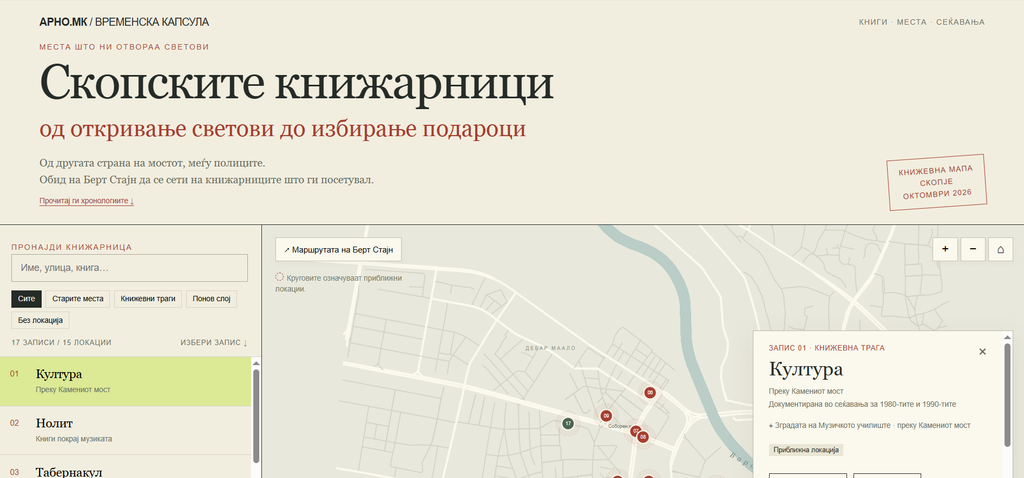
Skopje’s bookshops were also places for encounters like these. With books, with people, with ideas we had not known existed. Arno.mk’s new map connects old bookshop addresses with their stories, relocations and present-day continuations.
Bookshops That Gave Curiosity an Address
Kultura across the bridge and Nolit in the Faculty of Music building, Tabernakul at the Macedonian National Theatre and later at Rekord, the Misla literary salon opposite the cathedral, Ili-Ili at Tochka and then beside the Builders’ Hall — these places belong to different periods in Skopje’s reading life.
The map also includes Magor, Ikona, Matica, TRI, Gjurgja, Antolog, Akademska Kniga and other bookshop names. Some are backed by large publishing networks; others are smaller spaces with carefully selected stock. Some hosted book launches, exhibitions and discussions, so their histories intertwine with the city’s wider cultural life.
Ili-Ili is a particularly lovely example: the bookshop came before the publishing house. In a 2023 interview, Nenad Stevovikj recalls sourcing books from Belgrade and encountering Bernhard Schlink’s The Reader in the little bookshop at Tochka. The novel later became the first book in their publishing programme. A book brought in for sale became the beginning of another literary story.
What Do the Documents Say?
Memories preserve the atmosphere; documents help piece together the chronology.
The Kultura publishing company was founded in 1945. Its reports in the Official Gazette record a network of 16 shops in 1956, 19 sales outlets in 1957 and 21 bookshops in 1960, five of them in Skopje.
As for the bookshop in the Ristiḱ Palace, Kultura’s official website states that the premises have belonged to the company since 1958, citing its own archival records. This is a specific fact about the premises, distinct from the year the publisher was founded.
These distinctions matter for the other entries too: when the publishing house began, when the bookshop opened, when it moved, and the date of the document that mentions it. The map connects these traces, with sources alongside the timeline notes.
When Books Cannot Pay the Rent
The history of bookshops is also the history of their struggle to survive.
Tabernakul at Rekord, which opened in 1999, closed in October 2016. In his statement about the closure, editor Vancho Karanfilov explained that revenue was not covering costs and rent. A place that meant so much to readers no longer had a viable future in the business accounts.
In April 2026, Fokus found Kultura’s door on the square closed, with a notice announcing a move to 3 Dame Gruev Street. The article does not confirm whether the closure was temporary or permanent.
Behind such reports lies the question of what happens to reading habits when the place that helped create them disappears. An address can change in a single line of a notice. The habit of dropping in, browsing and having a chat is harder to relocate.
Did They Ever Sell Only Books?
Today’s mix of books, gifts, toys, notebooks and school supplies makes comparisons with the old bookshops almost inevitable. But documents have a way of upsetting even the most carefully arranged nostalgia.
In Neven Radicheski’s study of publishing policy in the 1950s, drawing on archival material discussed in 1959, books are described as having been of secondary importance in bookshops, since most sales were of office and school supplies. Kultura’s 1960 report also lists a department for the wholesale sale of such materials.
Books, then, have long shared their shelves with other merchandise. Today’s gift ranges continue and expand that mixture, sometimes to the point where the books are barely noticeable. The question is how much room remains for them — in the shop window, in the selection and in the conversation with the person behind the till.
Skopje still has bookshops offering carefully chosen literature, specialist selections and literary events. They too are part of the map, alongside places that have disappeared or changed address.
Open the Map, Add to the Story
The map contains 17 entries, with descriptions, timelines and sources. Some bookshops appear at several historical locations; for others, only a directory entry or literary trace has so far survived. Selecting an entry lets you explore its history and copy a link to that particular bookshop.
If you remember a bookshop that is missing, an old address, a photograph or a document, write to us at Arno.mk. Materials that can help establish locations and dates are especially welcome.
You can also tell us which book you found there. Some bookshops are remembered best for precisely that.