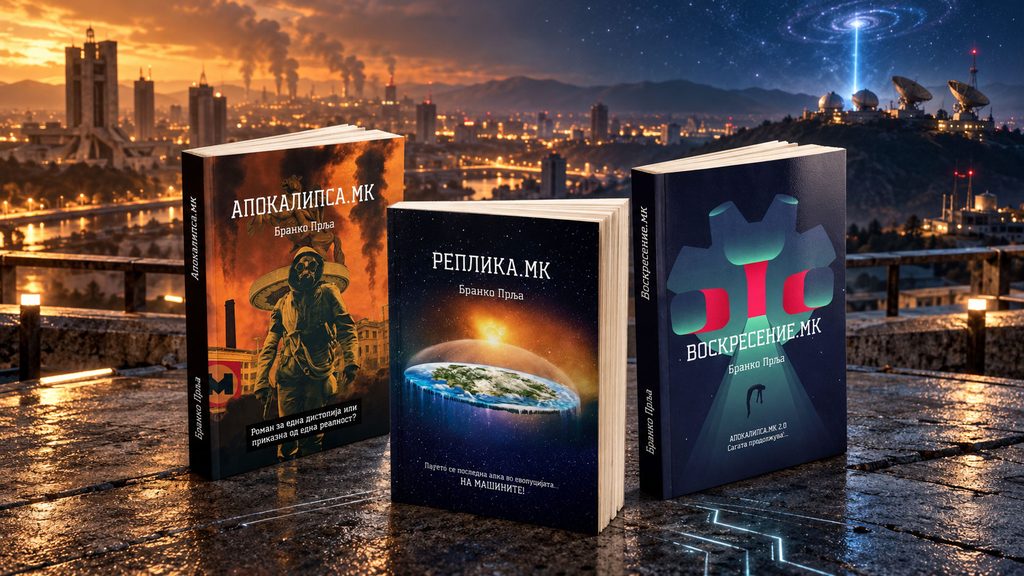
What would Macedonia look like under total state control, inhabited by replicants or transformed by science? Branko Prlja’s “Apocalypse.mk” trilogy offers three different visions of the future, each bearing many traces of our present. The trilogy’s redesigned website, featuring an animated dystopian scene, background music and PDF excerpts from all three novels, gives us an occasion to revisit these possible worlds.
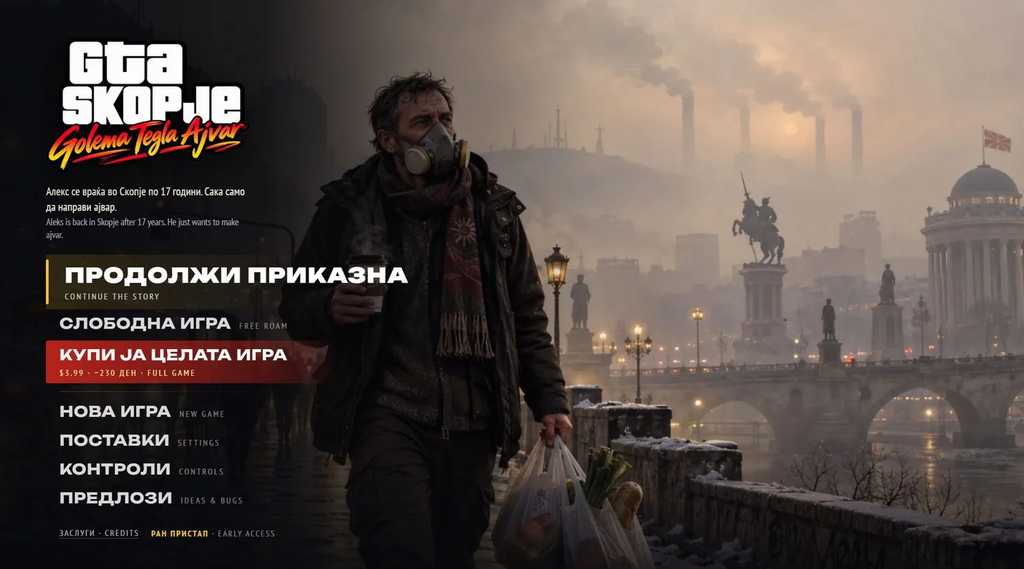
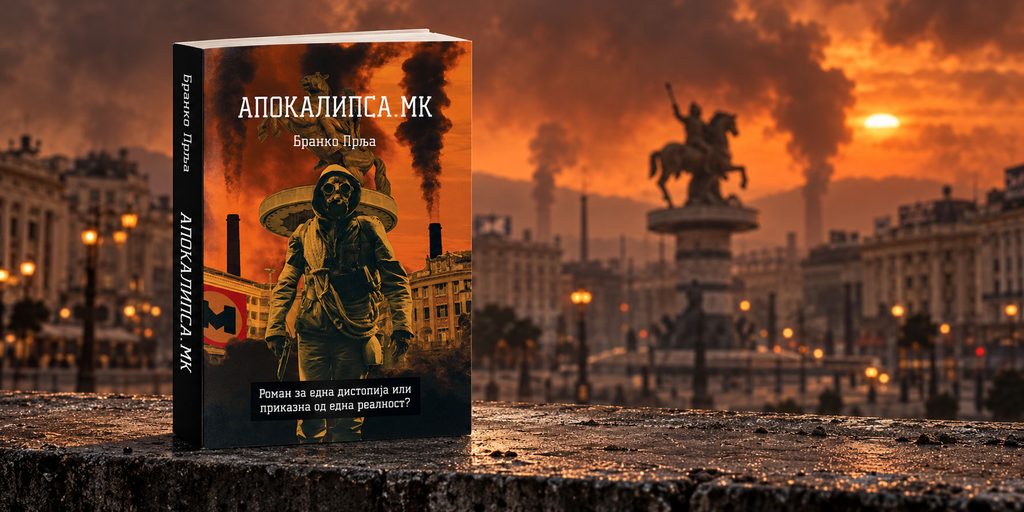
The occasion for this return to the “Apocalypse.mk” trilogy is Dejan Davchevski’s game “A Big Jar of Ajvar”, which we recently covered on Arno.mk. In it, Skopje becomes part of the story through its smog, speech, habits and contradictions. One of the opening shots, in particular, recalls the cover of Branko Prlja’s “Apocalypse.mk”, where the city likewise plays the role of a “protagonist” in a dystopian setting. The resemblance is coincidental, but intriguing as a visual encounter between two distinct creative visions of the same city. It is also a good reason to reopen the three novels, in which Macedonia takes on parallel lives shaped by the fears, contradictions and hopes of our own reality.
Skopje shrouded in smog, a state that dictates the truth, machines trying to become human and scientists searching for answers in space. In Prlja’s trilogy, familiar places take on different lives, while the everyday world we recognise becomes material for dystopia, science fiction and social satire. Macedonia appears as a totalitarian state, a technological experiment and the promise of a better world. In each version, people remain — or beings trying to become people — with their desires, weaknesses and need to find meaning.
Apocalypse.mk: When the State Knows What Is Best for You
“Apocalypse.mk” (2017) takes us into New Macedonia, where the State decides what people are allowed to do, think and desire. Music, films and entertainment are subject to bans, propaganda is constant, and smog penetrates even the most secluded spaces. Clean air is not guaranteed, but particular care is taken to ensure correct thinking.
Toma Hansov, a driver and secret writer, and scientist Nikola Sleyt try to find room for their own ideas in a world that tolerates no deviation. Amid illegal taverns, state slogans and the daily struggle to survive, the question arises of how much of oneself can be preserved when someone else regulates every aspect of life. This dark future contains many familiar details — enough to make the reader wonder where imagination ends and recognition begins.
“Apocalypse.mk” was a finalist for the 2017 Novel of the Year award, presented by the Slavko Janevski Foundation.
Replica.mk: Humanity as a Mission
In “Replica.mk” (2018), everyday human life is recreated by replicants. Buses, hospital corridors, family worries and conversations in taverns become part of an ambitious attempt to understand what it means to be human. The future, it seems, has decided to painstakingly reconstruct even our most ordinary inconveniences.
Supervisor Ido pursues the mission of “humanisation”, but his feelings and doubts open cracks in the programmed reality. He is expected to be a good husband, a caring parent and a diligent worker, while also making sense of the inconsistencies people carry within them. Can humanity be learned? Is a feeling any less real if the being experiencing it was created in a laboratory? And what happens when a machine begins to question its instructions?
Through the recognisable rhythms of everyday life in Skopje, the novel explores artificial intelligence, identity and free will, with humour arising from the clash between machine logic and the human habit of contradicting ourselves.
Resurrection.mk: A Better World, with the Same Old Human Weaknesses
“Resurrection.mk” (2019) opens up the possibility of a Reborn Macedonia: cleaner air, green cities, advanced technology and a society oriented towards science. Traffic has been removed from the streets, public space returned to people, and the Macedonium in Krushevo has become a scientific centre looking towards outer space. After the darkness of the totalitarian state, this future seems like a place where one can finally breathe.
But mysterious signals arriving at the satellite centre draw scientist Kliment Verov, his assistant Dobre and director Tea Novalkova into a story in which discoveries, ambition and personal relationships become dangerously entangled. Scientific progress can solve many problems; human vanity and the desire for fame prove harder to deal with. The search for answers develops into a science-fiction adventure with a crime mystery, in which every discovery brings new uncertainty.
Familiar Places, Parallel Lives
The three novels can be read independently, while together they create a broader story about freedom, power, identity and our desire to build a better world. Skopje and Macedonia play an important role: their neighbourhoods, institutions, monuments and habits make the fiction feel close, sometimes uncomfortably so. Behind the different social and technological systems lies the same concern — what we do with the world we have been given and what we leave behind.
The redesigned website brings the trilogy’s atmosphere to life through an animated dystopian scene inspired by the cover of “Apocalypse.mk”, accompanied by background music. PDF excerpts from all three books are available there — an opportunity to get to know their worlds and judge for yourself how far they are from our own.