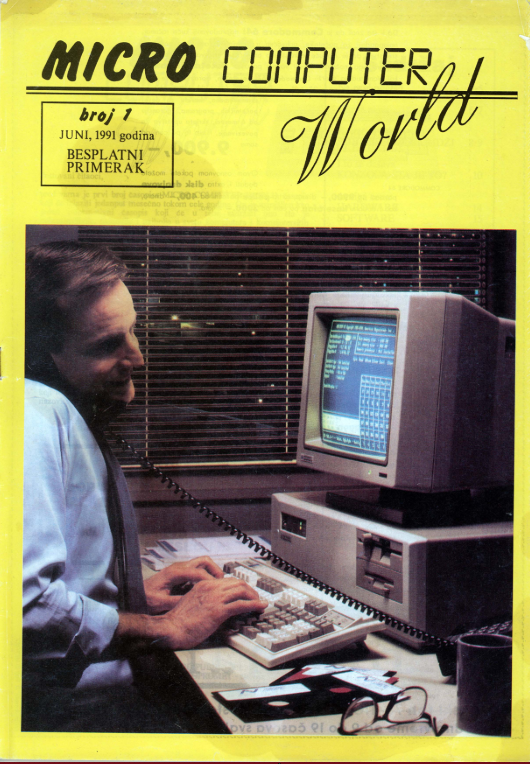
Free of charge, written in Serbo-Croatian and produced in Skopje, Micro Computer World brought together Amiga and Atari news, computer music, video games and local businesses. The surviving June issue reveals an ambitious publishing venture whose full history has yet to be reconstructed.
What if a relative in reunified Germany asked whether to send you Paperboy for the Lynx, and you had no idea what they were talking about? In June 1991, Micro Computer World used this example to introduce its readers to consoles. The article “Konzola – šta je to?” (“A Console — What Is That?”), on page 10, explains that these were devices designed for gaming that were already attracting considerable interest in Western markets. The relative in Germany appears as a potential intermediary between the latest international technology and the local user.
This detail captures the magazine’s atmosphere: curiosity, enthusiasm and a desire to keep up with the world of computers. Its editorial office was in Skopje, and it was published in Serbo-Croatian. In the masthead and editorial on page 3, MCW describes itself as an independent monthly magazine, published by MICRO PUBLISHING. The cover says “free copy”, and the editorial explicitly identifies it as the first issue.
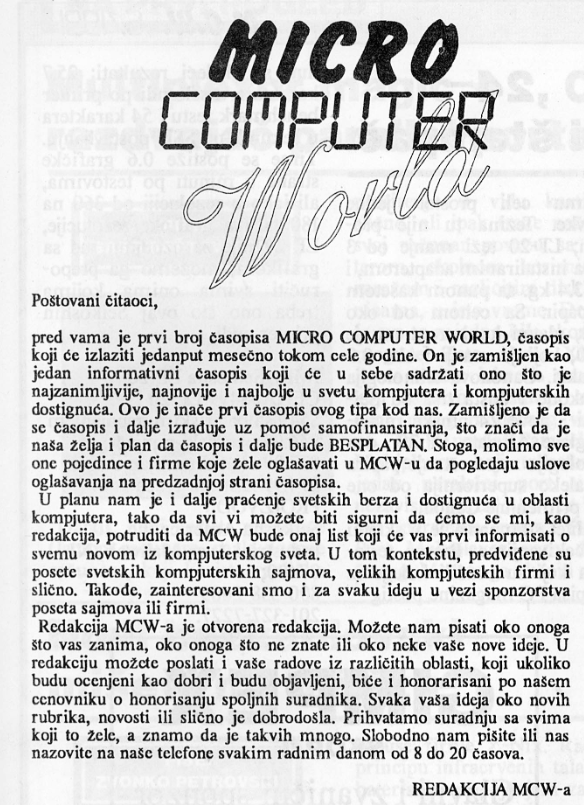
The editors announced an ambitious schedule: publication on the 30th of every month, coverage of international developments, and visits to computer fairs and companies. Readers were invited to send questions, ideas and articles of their own, with payment promised for published outside contributions. This was the programme of an editorial team expecting to build an audience and a network of contributors, although we do not yet know how many of these plans were realised.
A Skopje Address, a Serbo-Croatian Edition
The editor-in-chief was Dejan Bileski, his deputy Panche Trajanovski, the technical editor Ljupcho Trajanovski and the proofreader Zhoanita Trajanovska. The specialist editorial team listed Sasho Bashtovanski, Irena Andonova, Kristijan Danilovski, Marjan Jankovikj, Natasha Korabovska, Sasho Kmetovski and Marjan Nikolovski. The editorial office was at 1b Tome Arsovski Street in Skopje.
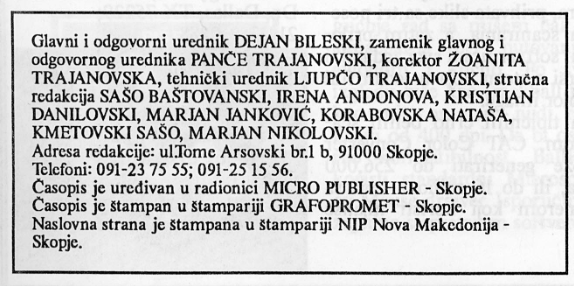
Prepress work was carried out at the MICRO PUBLISHER – Skopje workshop, printing at GRAFOPROMET, and the cover was printed separately at NIP Nova Makedonija. The masthead distinguishes between the publisher’s name and that of the prepress workshop; their legal and organisational relationship remains unestablished.
The use of Serbo-Croatian and the presence of advertisers from Macedonia and Serbia suggest an orientation towards a wider Yugoslav audience. However, this is not sufficient evidence of the geographical reach of distribution. One confirmed Skopje outlet is the Fina bookshop and video store at 10/2 Pandil Shishkov Street, which also describes itself in its advertisement as a distributor of MCW.
The Computer as Entertainment, Tool and Musical Instrument
The surviving issue has 28 pages and a strong interest in the Amiga and Atari ST, alongside PC news and advertisements. Its contents range from printers, scanners and mice to music software, consoles and video games. The computer appears as a tool for work, creativity and play, with practical advice for readers wanting to expand its capabilities.
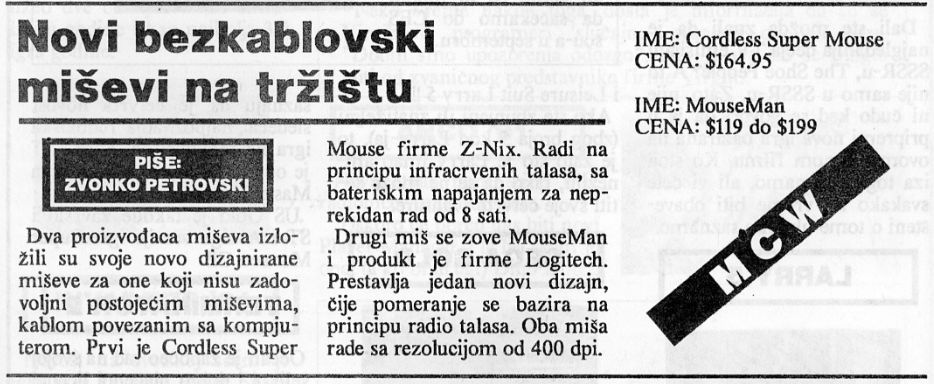
The “Na prvi pogled” (“At First Glance”) section, on page 4 and page 5, introduces the Seikosha LT-20 portable printer, an add-on for obtaining colour images with a monochrome handheld scanner, wireless mice and a parallel-port expansion device. The innovations are explained through specific needs: how to print while travelling, connect more equipment and work without a mouse cable.
Two pages are devoted to stereo add-ons for the Atari ST: the first part on page 8 and the continuation on page 9. The comparison examines connectivity, software support, capabilities and prices, ending with ratings and a recommendation.
Sound also receives attention in “Sonix – živa legenda među velikanima” (“Sonix — A Living Legend among Giants”), on page 18, written by Kristijan Danilovski. The author explains composing on the Amiga using samples, instruments, notes and MIDI. Readers are encouraged to experiment and create music themselves.
The author’s name now opens up an interesting avenue for research. Kristijan Danilovski is also the name of the co-founder of FX3X, the Skopje visual effects and animation studio established in 1997. The matching name and related field deserve investigation, but without direct confirmation we cannot claim that the MCW writer and the studio’s co-founder are the same person.
News from the World Arrives on Paper
MCW openly reveals how it obtained some of its information. The Seikosha feature refers to tests in PC Magazine, while the comparison “Ah, ti miševi” (“Ah, Those Mice”), on page 20 and page 21, states that it also used existing tests from foreign magazines. The sections listing Amiga hardware prices and software prices compile offers the editors found in the foreign press and considered good value.
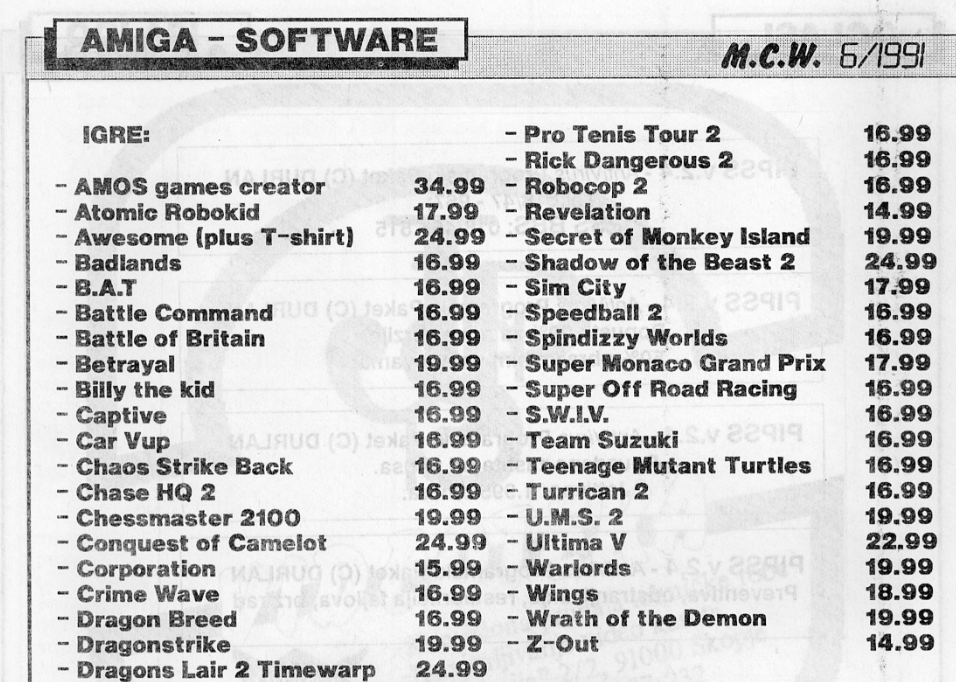
Prices are in British pounds, with a note that they include VAT but exclude customs duties. Other features include dollar prices and contact details for foreign manufacturers. For local readers, the magazine acted as an intermediary: it explained what existed, how much it cost and where it was made, while obtaining it remained a separate challenge.
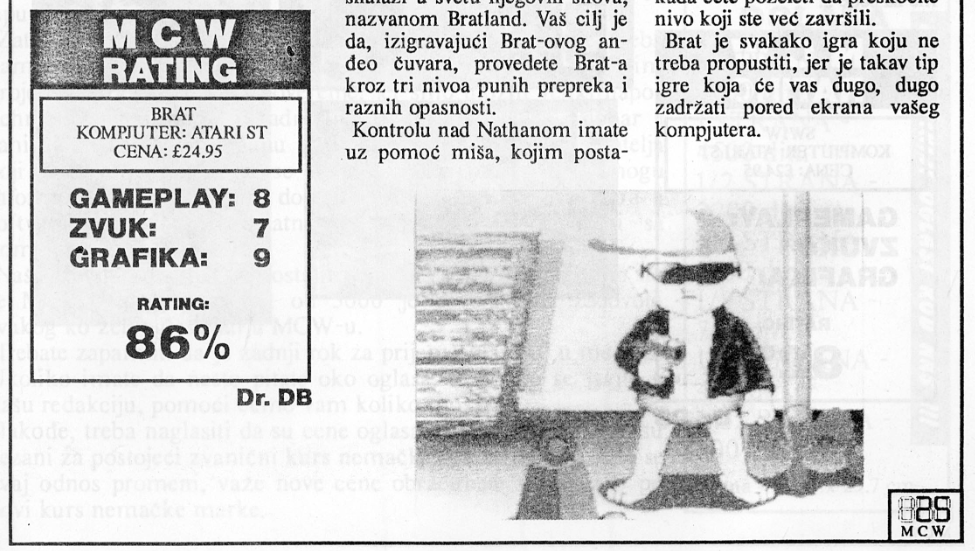
Video games occupy a substantial amount of space. “Game news” features The Secret of Monkey Island, Leisure Suit Larry 5, Space Quest IV and announcements of games based on Terminator 2 and Hudson Hawk. The game of the month is Wrath of the Demon, with a review beginning on page 22, followed by Elvira on page 24, Brat on page 25 and SWIV on page 26. The ratings assess graphics, sound and gameplay separately, and the reviews have the conversational tone of writers eager to share their excitement. Several are signed “Dr. DB”, a pseudonym whose identity has not yet been confirmed.
A Free Magazine with a Business Plan
Advertisements are integral to MCW’s intended business model. The editors wanted the magazine to remain free and invited companies to support it through advertising. On the penultimate page, containing the invitation and advertising rates, they state a print run of 5,000 copies. Prices are in dinars, tied to the stated Deutsche Mark exchange rate of 1:13. The circulation figure was published by the editors; there is currently no independent confirmation of how many copies were actually printed and distributed.
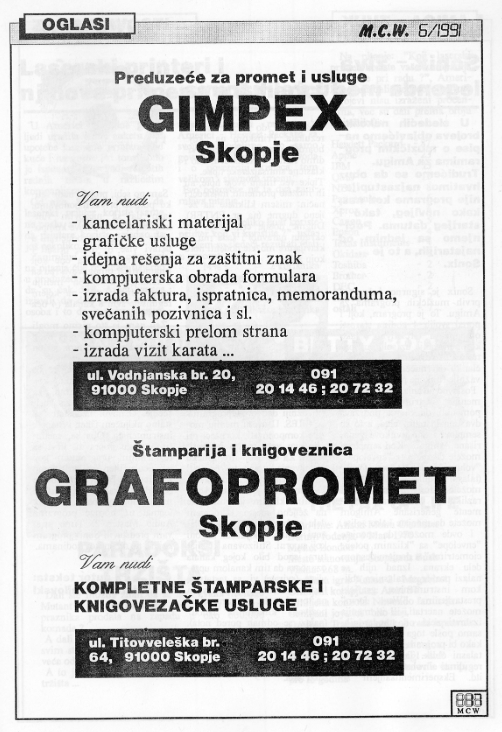
Skopje’s GIMPEX is named as the main and official sponsor of the first issue. Its advertisement on page 17 offers graphic services, desktop publishing and the production of business materials. GRAFOPROMET, the printer named in the masthead, advertises on the same page, with the same two telephone numbers but a different address. The shared contacts indicate a business connection, but do not establish ownership.
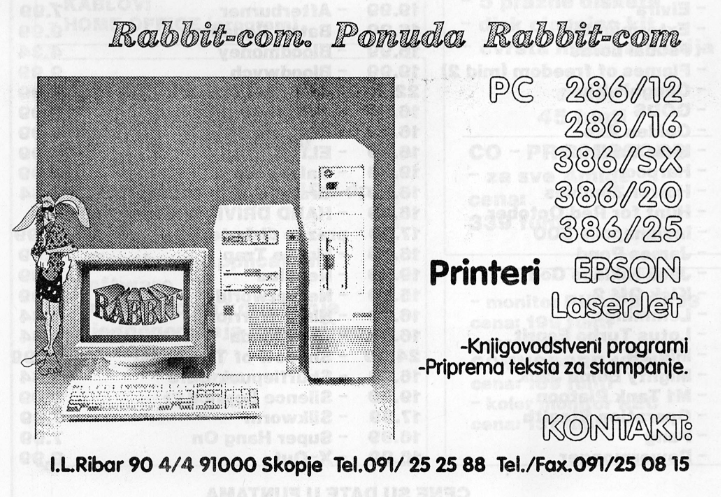
The other Macedonian advertisements add to this picture. Rabbit-com, on page 13, offers 286 and 386 computers, printers, accounting software and text preparation for printing. Fina sells textbooks and school supplies in instalments and rents video tapes. These advertisements reveal part of the local network in which computing equipment, graphic services, printing and video culture came together on the pages of a single magazine.
Among the advertisements is an unusual product: the dowsing “neutraliser” SONPETHRIST, on page 16, with claims of protection against various forms of radiation. The advertisement uses one of the editorial office’s telephone numbers and offers a special “MCW price”. This raises a question about the editors’ role in the offer, while the health claims remain unsupported within the advertisement itself.
A First Issue with Many Promised Follow-ups
Throughout the magazine, readers are repeatedly told what will follow: new music programs, more computers in the price lists, further news and future reviews. The editors write with the expectation that this is the beginning of a regular publication. The surviving copy confirms that beginning, but does not reveal the project’s fate.
Based on the traces found so far, it appears that only the first issue of Micro Computer World, dated June 1991, was published. This remains a hypothesis, however: no subsequent issue has been found, nor has there been confirmation from the editors that publication ceased after the first edition.
Even with these unanswered questions, Micro Computer World is a valuable record of a Skopje computing and publishing initiative from 1991. Its pages contain international news, local addresses, practical instructions and a belief that an audience existed for all of this. If anyone has another issue or remembers how it was created and distributed, their contribution could help give this story a continuation.
The June issue can be browsed in the ex-YU Računalniška scena archive, and a PDF copy of the complete issue is also available.