From Dors, Zizi and Music Garden to Kocka, Crkva and Pločnik—an attempt to preserve the city as one generation remembers it
Unless otherwise indicated, linked content is in Macedonian.
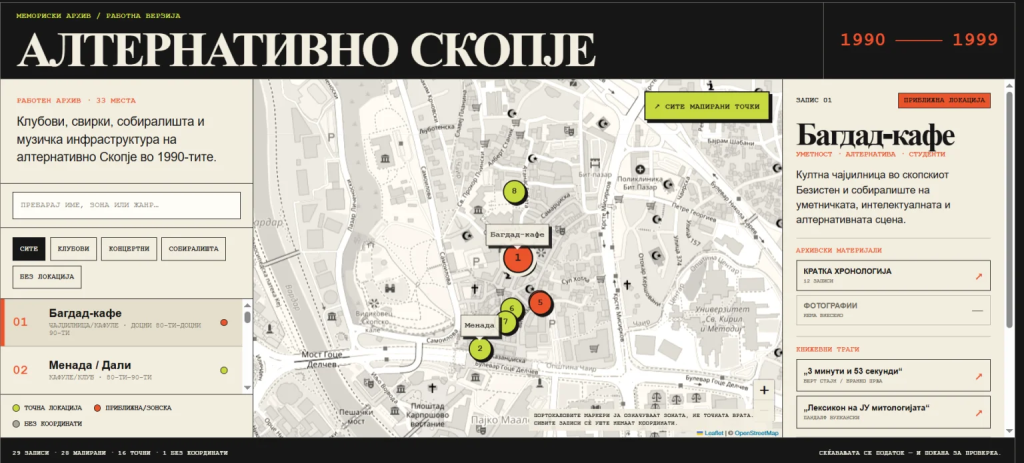
Try it out—and if you would like to learn more about the map’s history and methodology, read on.
How Did This Map of Alternative Skopje, 1990–1999, Come About?
The idea for this map did not begin as a plan for a digital archive. It began with a Facebook comment.
In February 2024, beneath a post by Strezo Čubalevski in the “Old Skopjans” Facebook group about Skopje nightlife in the 1990s, I noticed that the usual retrospectives tended to remember the larger, more commercial discos, while the small alternative clubs, basements, teahouses and informal gathering places had almost vanished from the story.
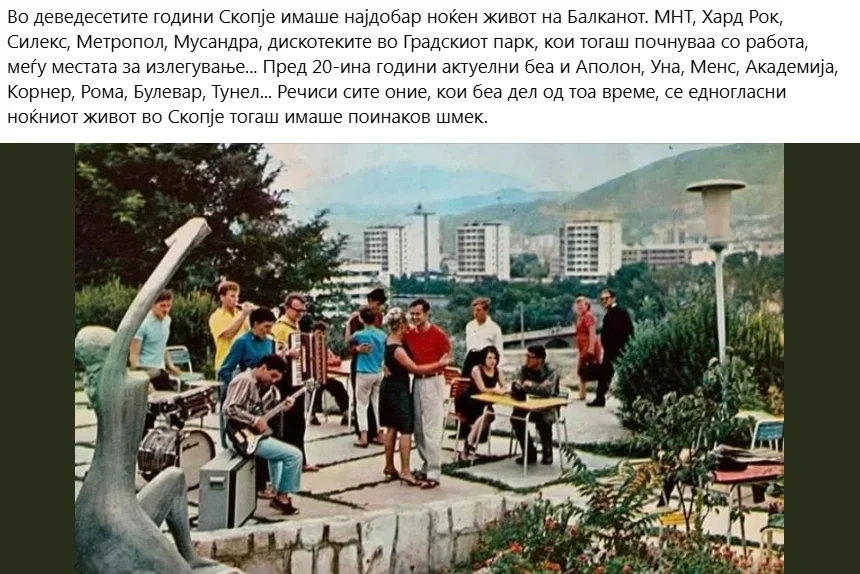
In a comment, I began listing the places I felt were missing: Dors, Music Garden, Zizi, New Age, SF, Poni, Medium, Dvaeskec, Džadžo, Baghdad Café, Menada, Lady Blue, Zot, Marakana… Other participants joined in with additions, corrections and memories of their own. Rock Energy, Arkus, Subway, Vulkan and other long-vanished names began to surface.
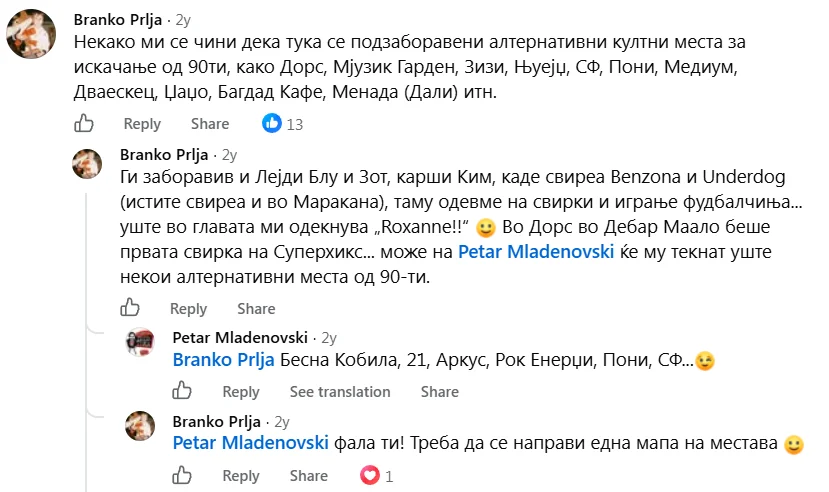
At first, it was merely a list drawn from memory. But each name immediately raised new questions: Where exactly was it? When was it open? What music did it play? Who performed there? What had occupied the premises before it, and what came afterwards? Was there a photograph, a poster, a ticket—or at least one more independent testimony—somewhere out there?
And so the list began to grow into research, and the research into a map.
An Extension of Arno.mk’s Informal Archive
The idea did not emerge in isolation. It was a natural continuation of Arno.mk’s long-standing archival work and several related projects seeking to preserve the small, easily overlooked traces of the past.
Through “Time Capsule”—both the website section and the Facebook group—we collect photographs, newspaper clippings, local brands, vanished shops and fragments of everyday life. “Yesterday’s News” brings old news reports back into circulation, demonstrating how yesterday’s news can become a historical document over time. “Time Capsule: Signs and Lettering” archives old shop signs, advertising boards, typography and visual identities that are disappearing from façades even as they continue to live in collective memory.
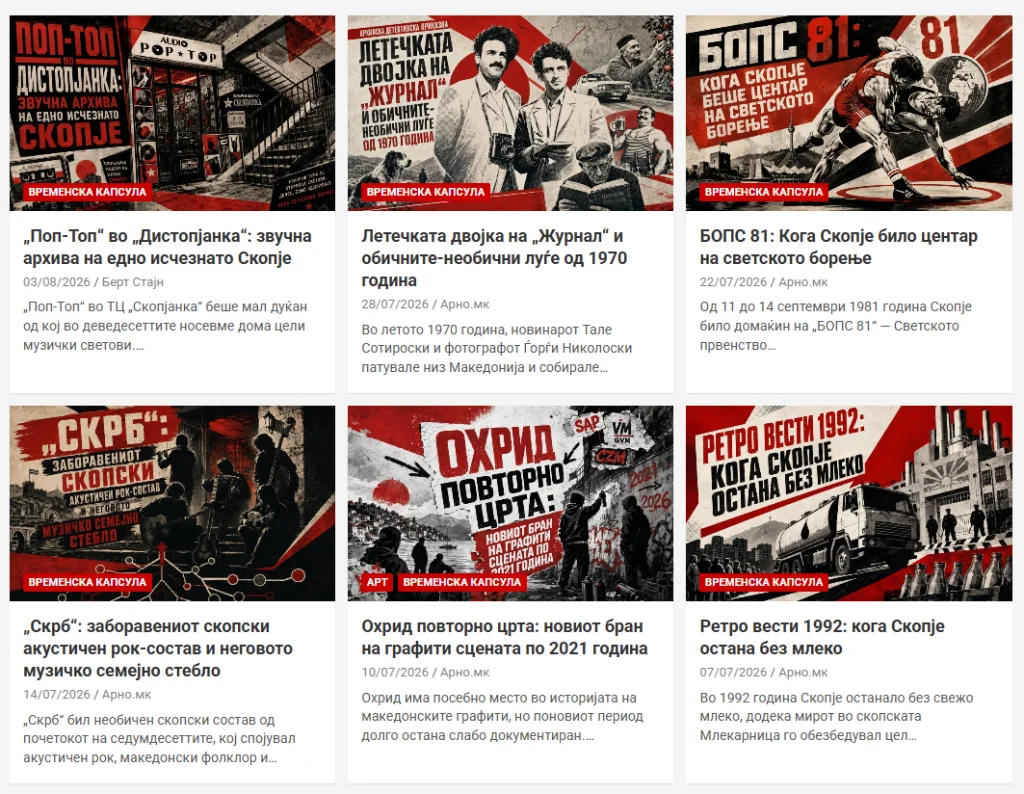
With a similar aim, Grafit.mk and our articles about Skopje graffiti document walls as a temporary urban archive: layers that continually appear, are covered over and disappear. Arno.mk’s articles about old buildings, neighbourhoods, businesses, street signs, graffiti and urban micro-locations are all part of the same effort to record what institutional archives often fail to recognise as important.
The Map as a Continuation of Our Archival Work
The interactive map “Alternative Skopje” extends this archival logic from objects and visual traces to the social topography of the city.
It archives not only the location of a particular door, basement or bar, but also what happened around it: who gathered there, what music they listened to, where they went afterwards, what they bought from the nearby shop, and how a perfectly ordinary place became a generational toponym.
This is an informal, open archive of the city. It is built not only from official documents, but also from old photographs, books, concert tickets, newspapers, forum discussions, Facebook comments and personal memories. These sources carry different degrees of weight and accuracy, but together they allow us to reconstruct part of a city that has almost entirely disappeared in physical form.
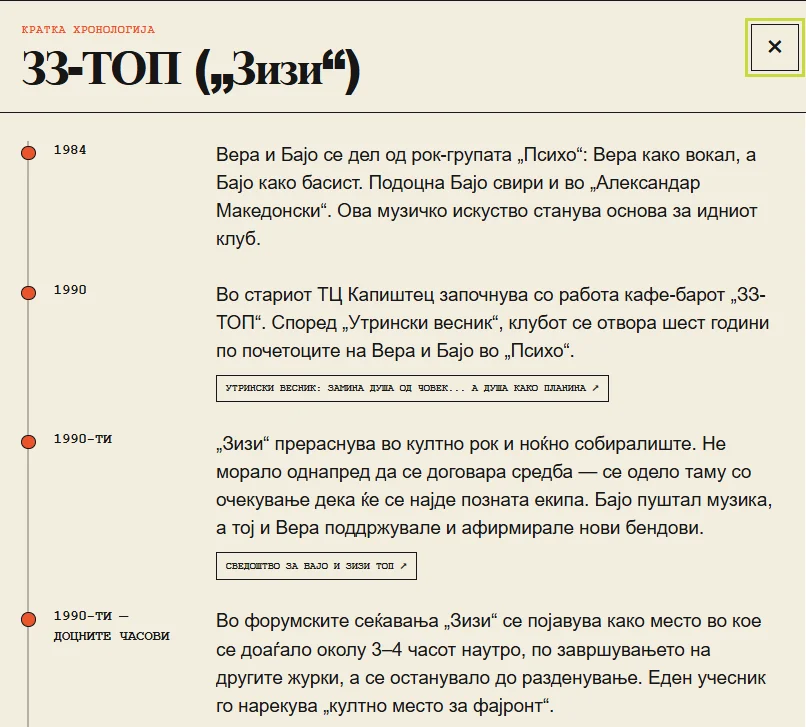
Personal memories of live shows at Dors, table football at Zot, mosh pits at SF and Music Garden, and endless conversations at New Age began to connect with old newspapers, music encyclopaedias, interviews, photographs and archived websites. Public gathering places joined the clubs on the map: Kocka, Crkva, Fontana, Pločnik, the benches near London and the little shops that stayed open late.
It became clear that we were not merely mapping venues, but creating the cultural topography of a generation—a network of clubs, concert spaces, teahouses, benches, pavements, parks and little shops through which Skopje’s alternative youth moved.
A city does not, in fact, disappear all at once. First, a venue closes. Then its sign comes down, the owner changes, the premises are subdivided, or the entire building is demolished. Benches are moved, graffiti is painted over, and place names slowly disappear from everyday speech.
In the end, a sentence remains: “We’ll meet in front of the Cathedral,” “We’re going to Zot,” “We’ll meet at Zizi,” “See you at Kocka.”
The interactive map “Alternative Skopje” is made from sentences like these.
The Trajectory of a Generation’s Youth
Alternative Skopje consisted of more than venues with a bar, a sound system and opening hours. It was a network of small spaces and urban microtoponyms between which young people travelled on foot.
In front of the Cathedral—or simply “at Crkva” (“the Church”)—friends would meet and plan the evening’s route. From there, they might continue towards Zot, Subway, SF, Bunjakovec, the City Wall or City Park.
At Dors, they listened to goth and rock, candles burned and the air smelled of incense. It was there, on 3 March 1994, that Superhiks played their first official show before an audience of around fifteen people.
At Zizi Top, there was no need to arrange a meeting in advance. You went there expecting that someone you knew would surely turn up. At Music Garden, people moshed to Sepultura, concerts and the Strip & Sound festival took place, and the police occasionally stopped the music. At Marakana, live performances continued for decades.
Lady Blue, Energy, Poni, Bravo, Vulkan, Bootleg, New Age, Menada and Flok/Balet represented different phases and faces of Skopje nightlife—from rock, metal and punk to hip-hop, electronic music, jazz and an Oriental atmosphere.
The Old Bazaar had another, equally important route: Galerija 7, the Bezisten, Baghdad Café, Džadžo, Dvaeskec, Kapan An and Kuršumli An. Some were teahouses and cafés; others were galleries, caravanserais or improvised concert stages. What they shared was the opportunity they provided for musicians, artists, writers, students and everyone who did not see themselves reflected in the city’s dominant social patterns to meet.
Warm-Up Spots Before a Night Out
And then there were the places that were not venues at all.
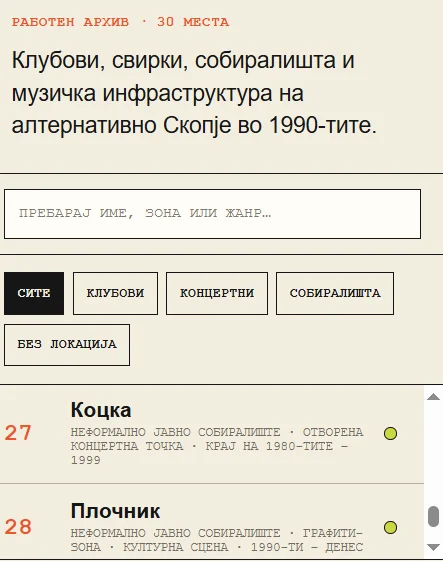
Kocka, on the city square, was a punk gathering place and an open-air concert spot. Fontana, in City Park, was a place for beer, music and waiting for friends. Pločnik, behind the Cathedral, grew from a subcultural gathering spot into a skate zone, graffiti gallery and venue for concerts, screenings and festivals. The benches near London were a meeting place for the alternative crowd and users of the old IRC channels.
The map also includes a separate entry for “The Shops.” This was not one particular shop, but an entire nocturnal infrastructure: Slavija in Debar Maalo, the shop opposite KIM, the shops around the City Wall and the Ministry of the Interior, and Dragstor Beti. People bought cheap beer, sunflower seeds, cigarettes and sandwiches there, while the steps and pavements turned into improvised clubs with no admission fee, security or minimum order.
What Does the Map Contain?
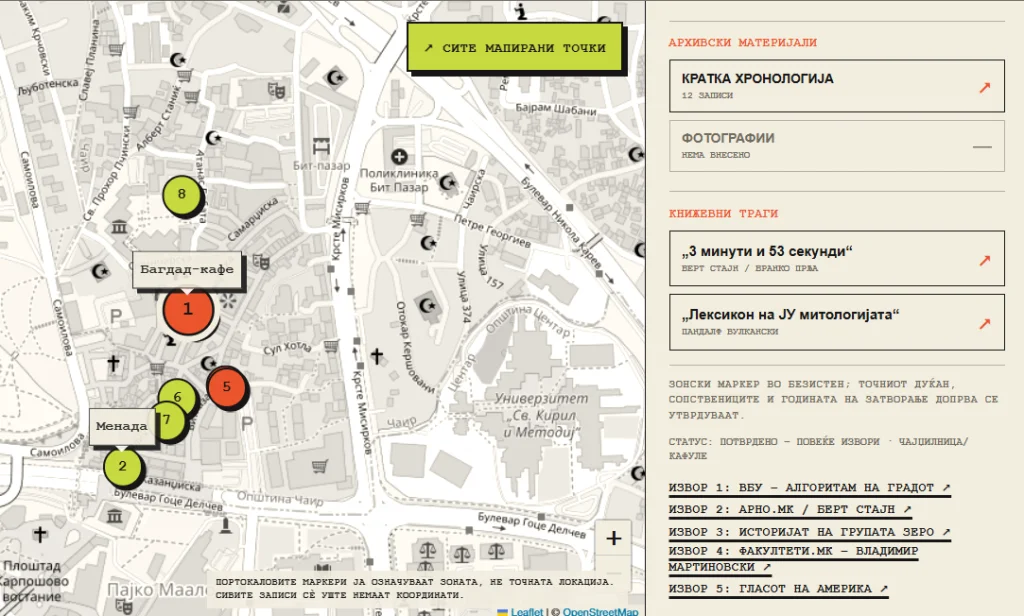
Each place is presented as a small archive entry. Alongside a basic description, entries may include:
- an exact or approximate location;
- period of operation;
- musical and subcultural affiliation;
- a brief timeline;
- photographs;
- literary traces;
- news articles, interviews and archival records;
- forum posts and personal testimonies;
- notes on accuracy and open questions.
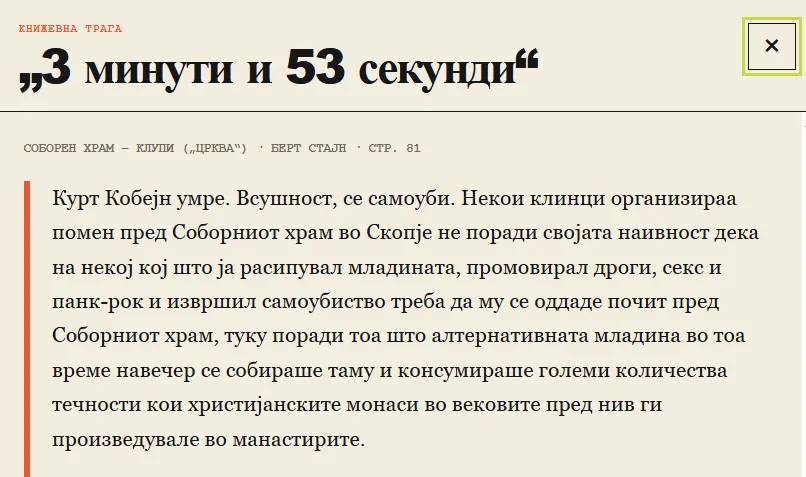
The literary excerpts have not been added merely as illustrations. They show how the places were experienced from within: their light, smell, music and smoke, the price of a beer, the conversations, and the feeling that you truly belonged somewhere.
Clicking the book icon in the “Literary Traces” section opens a separate window containing the excerpt. Timelines and photographs also open separately, allowing the main map to remain easy to navigate.
The Archive Remains Open
The map is complete as a first full version, but the research can never be final. We are still missing exact opening and closing years, the names of owners and DJs, photographs of interiors, concert posters and precise locations for some of the venues.
If you recognise an incorrectly placed marker, know what occupied a space before or after a particular club, or have a photograph, ticket, flyer or personal testimony—send it to us.
To someone, it may be nothing more than an old photograph of a table with a few bottles. For the history of the city, it may be the only evidence of a place that no longer exists.
A city is made not only of the buildings that have survived. It is also made of places that have disappeared, but continue to live in its language, music and people’s memories.