There are cities that speak loudly – through squares, façades, and official monuments. And there are cities that speak quietly – through traces of paint, through tags on walls, through spontaneous layers never meant for tourist brochures. Skopje belongs to this second category. Its true urban memory is not read only from textbooks, but from peeling paint, overwritten layers, and tags that persist between election slogans and concrete greyness.
It is precisely there, within this unofficial topography of the city, that Vagabundler appears – not as a random passerby, but as a careful reader. As an archivist of the present. As a silent chronicler of urban poetics.
Vagabundler is not a tourist blog. It is a fascinating blend of travelogue, visual archaeology, and love for art born outside of galleries. A platform that voluntarily and with dedication documents the pulse of alternative scenes across the world, with deep respect for the artists and awareness of the cultural context in which they create.
Skopje through the Lens of a Foreigner
At the beginning of October, Günther Michels from Vagabundler arrived in Skopje with a camera, a notebook, and quiet curiosity. The result: over 7,500 photographs, carefully collected from neighborhoods, alleyways, peripheries, and places rarely represented in official city imagery. At the moment, more than 2,800 photographs are already online, mapped and accessible to the public – as a digital diary of Skopje’s visual soul.
Each marker on the map is not just a point – but an entrance into a micro-universe of color and style. Something that does not last forever, but through this approach gains a second life: that of memory.
Parallel to the visual documentation, 12 interviews were conducted with local artists, six of which have already been published. These conversations are not merely Q&A sessions – they are testimonies of generations creating without fame, but with inner drive.
Interviews as a Living Document of the Scene
A special place in this Vagabundler visit belongs to the series of interviews with Skopje’s street artists -conversations that go beyond biographies and techniques, functioning instead as intimate maps of their journeys through the concrete memory of the city. Through the voices of Ashe, Drash, Miks, Smooth, Rask, and Zork, Skopje emerges not as a random surface for painting, but as a living organism, a symbiotic relationship between wall and hand, between night and color.
They speak of the first cheap spray cans and uncertain lines, the influence of local crews, the importance of Graffiti Shop Hrom as a cultural nucleus, the night actions and morning walks past their own traces. A deeper theme unfolds: the relationship between legal and illegal, art and vandalism, personal expression and public space.
You can find the audio interviews here.
The Artists
ASHE reveals himself as an artist transitioning from the impulsive adrenaline of bombing toward a mature, carefully developed visual language. He speaks of graffiti as a space for personal catharsis and psychological cleansing, of the process as meditation, and of the constant struggle within the limited conditions of the local scene – from lack of materials to scarce legal walls. His expression moves between instinct and conscious aesthetics, an intimate yet powerful voice conquering the urban space.
SMOOTH carries his graffiti sensibility from the wall to the skin, developing a highly distinctive lettering style inspired by calligraphy and chicano aesthetics. His journey from sport to art is a story of discipline, transformation, and devotion, and his role within Nameless Tattoo Studio confirms the importance of collective spirit. Through him, graffiti becomes a tool for visually liberating the city from its monotony.
RASK stands out as a consistent writer, fully devoted to the letter as the essence of graffiti expression. Driven by rap culture and the energy of Getting Up, he sees the street as a space for visual emancipation of grey Skopje, where color becomes attitude and presence. His position is clear: letters are eternal, and graffiti is a way to claim the city and give it its own rhythm.
MIKS is presented as an artist who naturally merges graffiti, tattooing, illustration, and music into one creative organism. His path leads from skate culture and hip-hop to the walls of Skopje, evolving from characters to a personal style where letters and figures coexist. Through his voice, the scene emerges as a guerrilla, solidarity-based network where art is passion, identity, and survival strategy.
ZORK speaks from the position of an artist faithful to the essence of graffiti – the letter, the tag, and handstyle as pure urban expression. His play between Cyrillic and Latin scripts, style and anti-style, demonstrates a deep awareness of graffiti as culture, not mere decoration. The interview also highlights the role of Graffiti Shop Hrom as a condensation point of the scene, while his stance clearly positions graffiti as aesthetic resistance to urban greyness and commercial invasion.
DRASH is portrayed as a pillar of the Skopje scene – an artist who transforms letters into characters and walls into narratives. He speaks of graffiti as a living form that softens the city’s post-apocalyptic visual identity, giving it color, voice, and humanity. Through his dedication to projects such as Bushava Azbuka and Spraygrad, DRASH positions himself not only as a painter but as a guardian of cultural memory and urban identity.
Arno.mk: The Inner Voice of a Scene
While Vagabundler places the Skopje scene on the world map, Arno.mk reads it from within – as a chronicler who not only records but interprets. Our approach is carefully analytical, seeking to preserve context, process, and cultural layering behind every graffiti piece. Over the years, this dedication – above all through the engagement and initiatives of designer and writer Branko Prlja – has evolved into:
- The archival group “grafit.mk” sharing authors, crews, and locations
- A graffiti map with photo and geolocation
- The first graffiti magazine in Macedonia – GRRFT Magazine
- The poster Graffiti Timeline – 30 years of street art history
- The book Walls That Speak: Graffiti Stories from Skopje Streets by Bert Stein
- Interviews with artists and key scene figures
- The series Art as a Time Capsule
- The mini-project Animated Graffiti
- and much more…
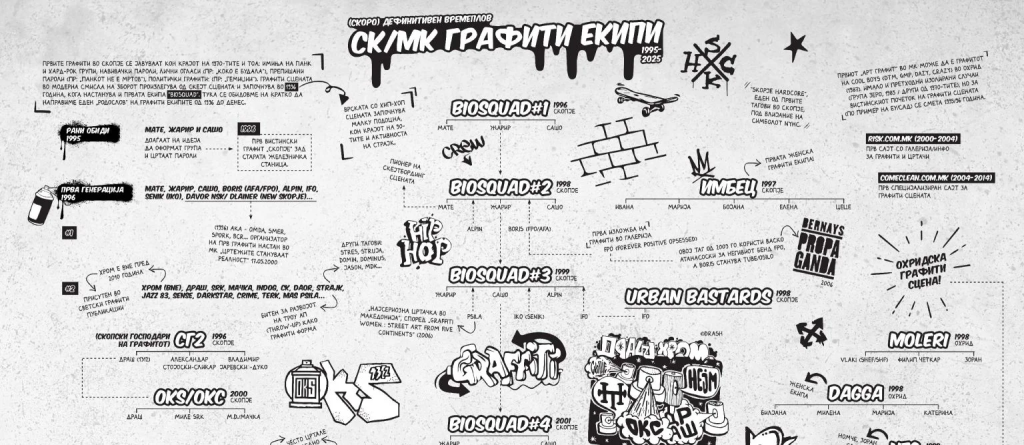
This is not just an archive. This is an attempt to preserve a visual language that exists parallel to official culture.
Between Oblivion and Visibility
Skopje’s graffiti scene long existed as an invisible layer of the city – present, but insufficiently recognized. It was there, in the shadow of monuments, behind new façades, among layers of political slogans and urban neglect.
The visit of Vagabundler changes this dynamic. It is not a compliment, but a recognition. Not an excursion, but an inclusion in a broader global dialogue on the role of street art in contemporary cities.
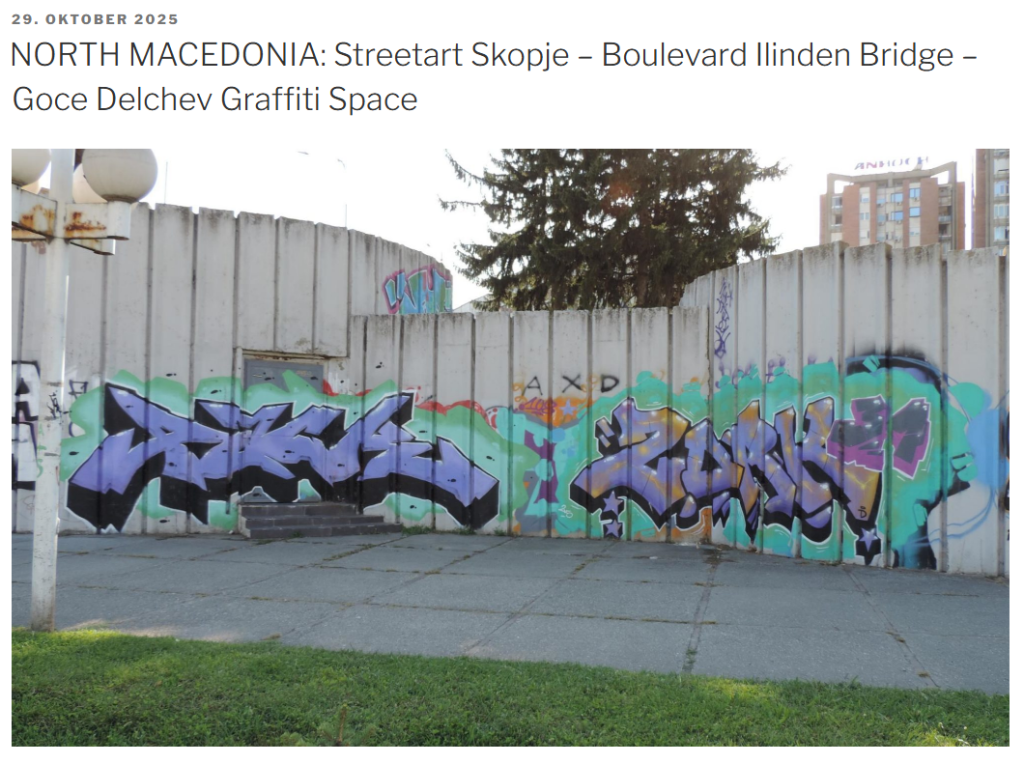
Walls as a Gentle Archive of Time
Graffiti is not eternal. It is fragile, transient, constantly exposed to erasure – or in Skopje’s context, more often to demolition. But in this very fragility lies its value. It is a testimony of moment, stance, resistance, and play.
Therefore, every photograph, every interview, every map, every text is a small attempt to preserve what might disappear tomorrow. Visit the graffiti of Skopje, and if you don’t know where to start, explore the Vagabundler map -it might lead you to an interesting piece you never knew existed in your own city.
This article was originally published in Macedonian.