At a time when hackers were romantic heroes and the internet promised freedom, something else was born—a digital mythology that devoured its own idealism. “Confession of a Cyber-Terrorist” is irony and prophecy at the same time: a story of how data becomes religion, revolutions turn into links, and truth into a reflection of lies.
The author writes this text in the form of a newspaper from the future, where humor and absurdity are weapons against the mass hypnosis of media and corporations. This is not merely fiction, but a kind of digital diary of humanity attempting to “hack” its own reality.
01: Hackers
This story begins in the second half of the 20th century, in closed rooms left unventilated for days, reeking of a toxic mixture of sweat, intoxicating drugs, and serotonin vapors from neurosynaptic connections operating at gigahertz speed… decades ahead of their time.
We see a hacker, a baby boomer, a long-haired hippie with glasses and a joint between yellowed teeth, frenetically pounding at the keyboard. We see letters, numbers, symbols—but he sees corridors, secret safes, confidential documents. And look—a smile on his face, a pleasant current runs down his spine; he is excited. But what is he doing? Why does he leave the document, why doesn’t he simply run out of there with the dirty confidential secret about massacres carried out on government orders, the filthy secrets of Diplomat X, the backstage gossip?…
No—he is a hacker of the old school; for him there is one rule: look, but don’t take. They do it only to prove that they can! They are techno-geeks, kings of technology, but let’s be honest—they are losers with no contact with reality or desire to influence it.

02: Cyber-Punks
We jump a few decades and—boom!—we’re in the eighties. Inflated by the lyrics “Youth Is Getting Restless!” and raised on the breast of the technological revolution that made them healthy and strong technophiles, with the potential to become technocrats, the cyber-punks are born. Nasty guys, raised in the era of free love—they despise love; it reminds them of something pink and sticky. What excites them is grayness, darkness, heavy notes and leather clothing, zippers, chains, and whips; they are techno-fetishists, they have only two erogenous zones: the numbers 1 and 0.
Their maxim is: “Information must be free!” And they work on it—yeah, brother, the kids are working while you sleep, and they’re sure that one day they’ll wake you up!
Cyber-punks are riffraff, but smart riffraff; they are not idealists fighting for freedom of information—they’re just damn angry that all important information is in the hands of governments, which are in the hands of corporations. And cyber-punks hate corporations.
But cyber-punks, like punk itself, were fast, loud, and wanted to do as much damage as possible in the shortest time. That’s why they burned out; they stole too many codes, personal data, and credit-card numbers to change anything more than their own financial situation.
If we owe them anything, it’s the idea that “it is in the nature of information to be freely accessible.” That was their legacy for future generations.
At the turn of the century, a new generation of techno-creeps was born—the cyber-terrorists.
03: Cyber-Terrorists
“We are not hackers, by cyber-pagan gods! Those long-haired hippies suffered from the collective illusion that somewhere deep in the Universe harmony reigns. Nor are we cyber-punks—they went extinct along with the last books by William Gibson that were worth anything. Call us cyber-terrorists, because we will change the world, and this time we are serious!
We want to live in a world where data is free and power is in the hands of ordinary people, because everyone should have access to information. But unlike our predecessors, we will make it happen. How? By freely spreading information—whether corporate plans or top-secret government operations.”
Many years ago, a smart man said:
“There are indicators that the world is moving toward the domination of multinational corporations, whose growing monopolization of information achieves ever greater power over both individuals and nation-states. Our means of diplomacy, politics, espionage, and terrorism will be electronic.”
And he was right!
The End: The Revolution Is Dead
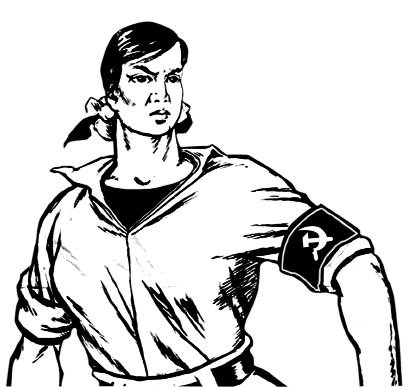
And then, on the cyber scene, she appeared—Viki Lee Xi.
She was so powerful that we all believed in her; she led us into collective freedom, revealing to the world secret documents that could permanently shift structures of power.
And finally, when we thought Viki would free us, she was falsely accused of mentally abusing the French chanson singer—Julien Lassan. Young people around the world protested in the streets, the spirit of 1969 was resurrected, and then—total collapse!
The young were first invited to share their views and photos from the protests on an internet platform called Facelook. They did protest, but their protest was virtual, lost in the network. Then they became so addicted to it that they forgot about the protests, the revolution, and Viki Lee Xi. The trap created by the secret services was more than successful.
And then…
Breaking news!
“From confidential sources we have learned that Viki Lee Xi is in fact a secret Chinese agent with an agenda—the destruction of the capitalist system!”
And now what?…
Nothing. It only confirms the old proverb:
“Truth is merely a reflection of a lie in the mirror of illusion…”
or was it the other way around?
Either way—we are publishing Viki Lee Xi’s secret documents.
Enjoy your reading!
Viki Lee Xi, cyber-revolutionary
Warning!
What you are about to read may reveal a truth you might not want to know.
You have been warned.
Sincerely yours,
Viki Lee Xi
(From the introduction to the book “News from Madness” (in Maceodonian), Goten, 2010)